Monthly Archives: October 2018

2018-19 Miami preview Part II: Forwards
OUT (6): Conor Lemirande (graduated), Kiefer Sherwood (turned pro), Carson Meyer (transferred), Austin Alger, Alex Alger, Willie Knierim.
IN (5): Jonathan Gruden, Noah Jordan, Monte Graham, Brian Hawkinson, Scott Corbett.
RETURNING (10): Srs. – Josh Melnick, Ryan Siroky, Zach Lavalle; Jrs. – Gordie Green, Karch Bachman, Carter Johnson; Sos. – Casey Gilling, Ben Lown, Phil Knies, Christian Mohs.
NOTES: Gordie Green hit his stride midway through his freshman year and has gotten better seemingly every game since, as he led the team in goals (15) and points (33) as a sophomore.
Newly-named captain Josh Melnick makes everyone around him better and finished with nine goals and a team best-tying 21 assists for 30 points in 2017-18.
Phil Knies was last season’s freshman goals leader with 11, including six in a four-game road trip in January, he finished with 20 points, and fellow college rookie Casey Gilling added 19 and was one of the team’s best in the faceoff circle.
Ben Lown (4-11-15) was the other significant contributing freshman up front.
Speedster Karch Bachman nearly tripled his rookie points output, posting 16 points including seven goals after earning six as a freshman. The Florida Panthers draft pick netted three goals the final four games.
Senior Ryan Siroky is the only other returning regular starter from last season. He dressed for 33 games and was of the team’s best hitters and played solid defense, contributing two goals and a pair of assists.
Zach Lavalle, Carter Johnson and Christian Mohs logged a combined 46 games, and Johnson locked down a lineup spot the second half of the season with his energetic play.
Not counting Johnson, that’s only seven every-night forwards back, meaning five other slots would be open each night. Even if all 10 veterans start that leaves two openings for newcomers.
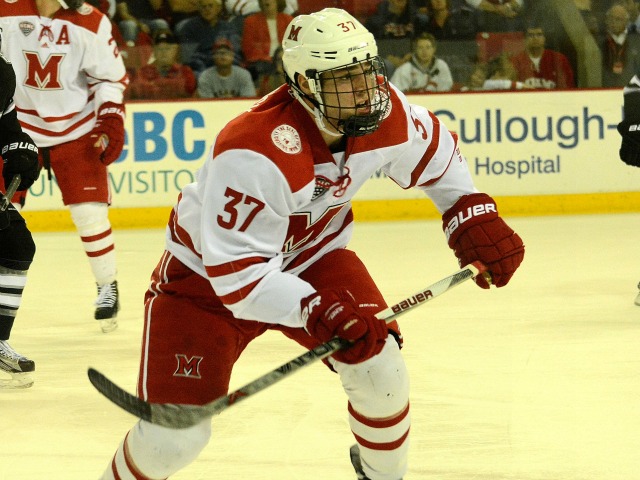
Miami forward Josh Melnick (photo by Cathy Lachmann).
“If you look at those guys, they took huge strides last year, especially toward the end,” Melnick said. Obviously those guys have to step into bigger roles now, and I think they’re ready for that. It’s easy for me to say they’ve been really good this preseason, but it’s 100 percent true. Also, the guys that are coming in are really exciting – you’ve got some really skilled and dynamic players all throughout the forward lineup.”
Of the freshmen, Jonathan Gruden is a near certainty to claim one of those lineup spots. Playing for the U.S. National Team the past two seasons, the Ottawa Senators’ fourth-round pick rolled up 34 points in 25 games vs. USHL competition last season as a 17-year-old while going plus-28.
Monte Graham has serious NHL pedigree, as he is the cousin of Wild center Charlie Coyle and former NHL forward Tony Amonte. A New Englander, the former Boston College commit boast plenty of juniors experience, as he has played two full USHL seasons.
Noah Jordan is 6-feet-5 and skated for North York in Ontario Juniors last season. He scored 18 goals in 2017-18, and the Toronto-area native led his team in playoff points.
Brian Hawkinson has three seasons of USHL experience and is known for his grit and leadership. He was the captain for Tri-City in 2017-18, where he notched 16 points.
Scott Corbett is another Carmel, Ind., product, the same hometown as former defensemen Cameron Schilling and Grant Hutton. He is known as more of a playmaker and has good size at 6-1 and 187.
“I think we’ve got like guys that are (solid), guys that need to take another step in terms of their production, and then we’ve got some guys that understand they’re playing a certain role, and they have to perform,” Miami head coach Enrico Blasi said. “I like the depth we have, it’s going to be a struggle each weekend to see who’s going to play, and that’s a good thing – that breeds competition in practice, and everybody has to elevate their game.”
Though Miami was below average offensively last season, the RedHawks finished ninth in Division I on the power play (23.2 percent).
Then again, MU’s defensive duo accounted for 13 of those 35 PPGs and managed just two markers in last season’s final 11 games on the man-advantage.
Depth was an issue among centers and wings, as only eight forwards were able to generate seven or more points last season.
“When we came here in the summer just to work on stuff, we actually started to get a lot better then,” Melnick said.

2018-19 Miami preview Part I: Overview
Since 2014-15, Miami has won just 36 games, its lowest three-season total since 1989-92.
As a result, the RedHawks parted ways with two assistants and 11 players this off-season and they hope the influx of new talent – both on the ice and the bench – will vault them to more victories.

Coach Enrico Blasi (photo by Cathy Lachmann/BoB).
With all of the moving parts within the program, game-action anticipation has never been greater. Fortunately for the RedHawks, opening night is Saturday vs. Alabama-Huntsville.
“I think you’re always excited to start a new season,” Miami coach Enrico Blasi said. “But I think with the last five months the way they played out, just focusing on games and getting better as a team and moving forward, I think everyone’s excited, I’m excited, we’re ready to go.”
Peter Mannino was hired as associate head coach at the end of March, and Joel Beal was named assistant in June.
Mannino, a former NHL goalie and NCAA Tournament champ with Denver, was an assistant at in-conference rival Nebraska-Omaha last season after winning a Clark Cup as the assistant of the USHL’s Chicago Steel.
Beal was an assistant at Sacred Heart the past five seasons and an associate head coach since 2016, and on the ice he starred at Union in the early 2000s.
“Peter is very outgoing, energetic, very positive, kind of throws a lot of things at you and makes you think about 10, 15 things at once, and Bealer is very systematic, very cerebral, thinks about things, makes sure that we’re not missing anything,” Blasi said. “Both are very positive – Bealer’s a very positive guy – both are hardworking guys, trustworthy guys you can count on. That’s what you want in a staff and that’s what you want out there recruiting for your program. The dynamics of the three of us – we all bring something different to the table and yet…we mesh together. With both of them, my conversations were very similar in the fact that I felt like we could connect right away and build from there. And I think we see the game the same way, I think we see the type of team we want to be, where the game is going, the way we want to develop our players and inspire our players and the process in which to do it. Those are all things that will continue to grow as we go through the days, and the games, and the practices, but we get along really well.”
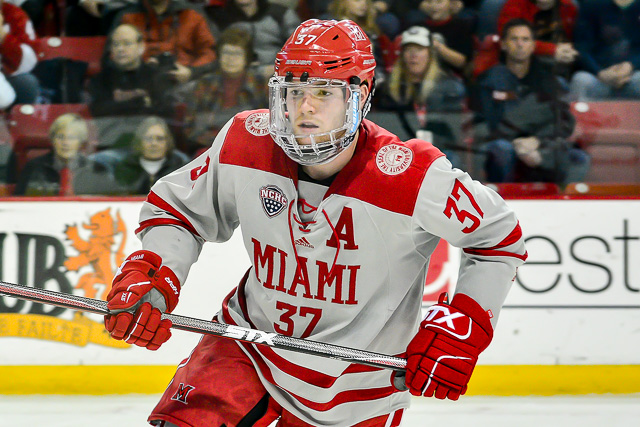
Miami’s Josh Melnick (photo by Cathy Lachmann/BoB).
Senior co-captain Josh Melnick said the energy the duo has brought to the program has been contagious.
“They’re obviously two younger guys and they bring sort of a different perspective to the locker room,” Melnick said. “As a whole, they’ve settled in really well, and I think they’re getting a good feeling of what our program’s about and also helping re-establish the things that we want to work on to get the program back to where it was in the past.”
Miami’s roster, which was not completed until late July, features five new forwards, four on defense and two in net. Two of the 11 are graduate students completing their fourth years of hockey eligibility.
“I think we’ve brought in some guys that will know their role – they were recruited to it,” Blasi said. “I think they’re a little bit older, we’ve got some Clark Cup championship-caliber players who have been through it, understand how to win a championship, guys that have been captains on their teams, and we have one (Jonathan Gruden) that played on the U.S. Development Team, played in the Worlds, and played with (the forward) that’s probably going to be the first overall pick in this (2019’s) NHL draft (Jack Hughes) and played on the same line with him. These are all positive things, and then you add two postgrads to the new faces, and we’ve got guys that are real positive and a tight freshman group.”

Grant Hutton (photo by Cathy Lachmann/BoB).
Both Melnick and defenseman fellow co-captain Grant Hutton love what they’ve seen from the newest Hawks.
“I think it’s everything we’ve expected and more,” Hutton said. “A lot of these guys are a lot of key, role players that know they’re here for a reason. You see it a lot in college hockey where guys may be goal scorers or big points guys in juniors or whatever it may be, and they get to college and they’re kind of shell-shocked. Gruden is our only true freshman at 18 years old and a lot of older guys that are coming in are mature, and I think that’s the biggest thing. Usually you talk about college hockey being a place where players have the opportunity to mature and develop, but it’s a huge plus when you get players that come in and have some of that maturity, some of that development. We’re pretty lucky with the group we have coming in, and I think it adds more excitement.”
Said Melnick: “They all assimilated right into things quickly – they’re all great people off the ice, and I think a lot of the reason we have high energy is because those guys have a lot of energy. They came here ready to work, and they know what the program stands for and what it’s been like in the past, and they’re ready to help get it back to that point.”
During the summer before the new players arrived, the returning players reached out to the freshman class to welcome them to the program, Melnick said.
The off-season didn’t start well for Miami. Within days of the RedHawks’ final game, it was announced that assistant coaches Brent Brekke and Nick Petraglia would not return as well as four players.
Two other prominent forwards also left the team early in the off-season, with one turning pro and the other transferring.
That’s on top of Miami not qualifying for the NCAA Tournament or even making it out of the NCHC quarterfinal round for the third straight season after qualifying for 10 of the previous 12 national championships.
“This is something that, I don’t look at this as a job, this is my life,” Blasi said. “When your life isn’t going the way you think it should go in terms of guys not playing up to their capabilities or even some of the things I might’ve done in the last couple of years that were wrong decisions. You assess, you evaluate, you try to be better – we all have opportunities to be better every day, we’re no different and I’m no different – and if I told you I wasn’t frustrated or disappointed in certain occasions, I’d be lying to you. But I can also tell you that I’m very proud of some of the things that have happened in the past couple of years. I believe in my heart that these are necessary steps that need to happen to move forward and become better. When we built the program, we went through some tough times, but nobody talks about those because nobody remembers those, everybody just remembers the wins and the Frozen Fours and the championships. I can tell you there were times where we had the same frustrations, the same disappointments, but they were necessary disappointments and necessary things that we needed to get through to get to the next level, and that’s what we’re going to do right now.”
Some positive things happened this off-season well. Multiple prior Omaha recruits switched to Miami following Mannino’s hiring, including defenseman Derek Daschke.
“Obviously at first it was a little difficult with having to (deal with) some difficult situations, to be honest with you,” Blasi said. “Once we started to kind of shape our team around the guys we have coming back, finishing off the recruiting and finishing off the staff, and getting together as a staff and kind of formulating our plan and getting to know each other on a different level, and then obviously have our team come back and work with them and kind of creating their identity. It’s been a lot of fun. ‘Reenergize’ is a work that we’ve been using a lot lately.”
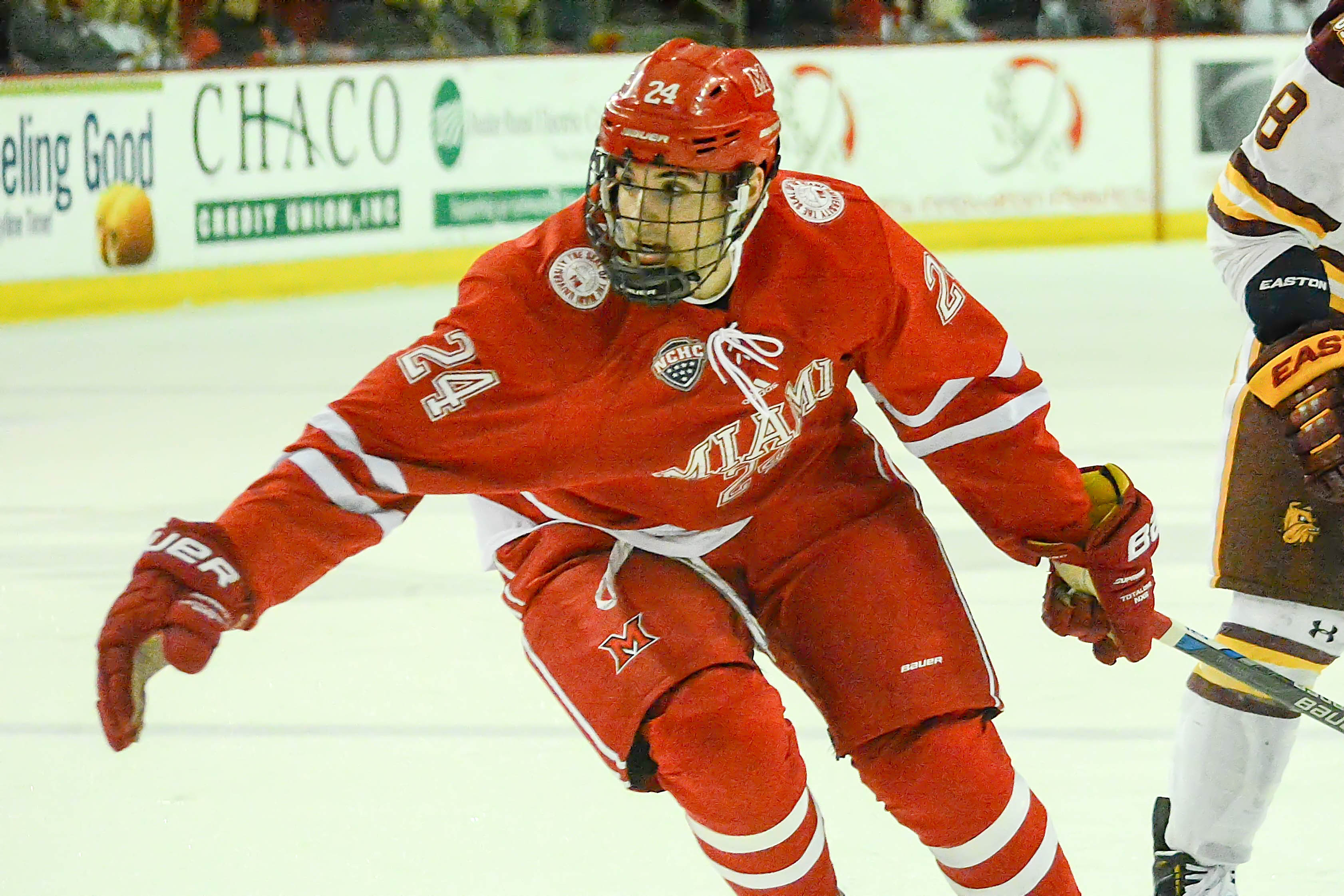
Miami’s Ryan Siroky (photo by Cathy Lachmann/BoB).
And both Melnick and Hutton, both seniors and destined for lucrative professional careers, announced they were returning this fall.
“I give Hudson, Melly a lot of credit, them and the senior class – Lavs (Zach Lavalle) and (Ryan) Siroky – that helped shaped the spring and the summer to make sure when these new guys came in, that our program was in a good place and we were going to hit the ground running.”
Miami played some quality hockey down the stretch last season, and Blasi said his team will seize that momentum and carry it into this campaign.
“Those are some of the things we were really proud of,” Blasi said. “To stick with it and to keep fighting, that’s a character trait that you can’t teach. And that’s something that’s in our locker room, that’s something that’s in our culture. I was very, very proud of the team and the way they played. Now, do we want to win at the end? Of course. Everybody does. But at the same time, you have to take a step back and assess the situation, and I believe that how we played was really important for the guys coming back in the spring and the summer and for our recruits, to say hey, we’re not that far off. We just need to maybe work a little harder, improve one or two percent. If everybody can do that, then we have something. When you’re in the moment, it doesn’t seem like it, and I know it probably doesn’t seem like it to the general fan – and we have great fans and great supporters, some of which have expressed their support and some of them haven’t, and that’s OK too – but when you take a step back and you see all the developments that have happened over the past couple of years, I think you’ll look back and say, hey, maybe if we didn’t go through that we don’t get to that next level.”
He pointed out that Miami was ranked as high as No. 14 in the PairWise after its big January home win over powerhouse Denver.
“It just shows that we have a group that isn’t rolling over, we’re not going to quit,” Hutton said. “We’re here because we want to be here, we’re here because we love each other, we love Miami, and we want to be the best possible hockey team that we can be every single night and ultimately reach our goal of bringing a championship back to Oxford.”
Blasi said that he, as well as both assistants, have been actively involved in recruiting this off-season and has hit the road with one or both on several occasions as Miami tries to fortify its roster for the coming years.
“I think the culture of the program is still very strong in terms of what we believe in and the way we do our business from day to day,” Blasi said. “We may tweak some things here and there but I think The Brotherhood and the family and the relationships and the process is still something that we still focus on, it’s still all about developing these young men to play at the next level or develop them to be better people on a day-to-day perspective. But at the end of the day, recruiting is your bloodline – that’s never going to change – and so recruiting is very important, and our team is very important. We have to make sure we’re focused on both equally and we’re doing what we need to do to help these men that we have get to the next level and win games and play at a high level, maybe reach levels that they thought they couldn’t reach. That’s part of what we do as coaches is inspire them and push them in a good way to make them play better than even they think they can.”
Though the season doesn’t start until Saturday, Melnick he noticed a marked difference in the locker room already.
“A lot of the times when people ask what’s most exciting about this year and what’s different, I think it’s the energy, and it’s just coming from everyone,” Melnick said. “It’s honestly kind of crazy to be around, because everybody’s so positive and confident and we just can’t wait to get out there.”
Check back for a positional breakdown of the RedHawks.

Q&A with associate head coach Mannino
He was the starting goalie during Denver’s 2005 NCAA championship season and played six NHL games before turning to coaching, and behind the bench he has already won a Clark Cup title in the USHL as an assistant with Chicago.
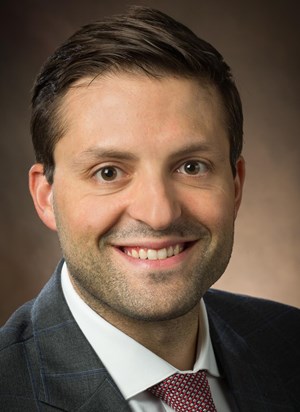
Peter Mannino (used with permission of Miami athletics)
On March 29, less than three weeks after Miami relieved both of its assistant coaches of duties, Peter Mannino was hired into the associate head coaching role.
Mannino moved to Oxford along with his wife, Alyta, daughter, Sienna, 3, and son, Luca, 1.
BoB: You were named associate head coach this off-season, so what would you want Miami fans to know about you from a coaching philosophy perspective?
Mannino: I’m a very approachable, honest coach. One that really dives into the experience I had when I played. I try to bring that to the table because I never want to forget those days. My brain is at the same level as what they’re going through. That’s just the way I approach things, the way we ask (the players) to every day – be honest, work hard and be approachable, have a two-way communicative relationship. That’s what I really, really want the players to know, is that we care about them. We’re here to push them, on and off the ice, take care of them when we need to, push them when we need to and make them earn everything that they’ve deserved up to this point. Kind of all those little attributes, those words kind of pile up together and that’s the way things go with me and the players.
BoB: You played at Denver and have coached at Nebraska-Omaha, so you seem like a perfect fit at Miami in terms of a coach who understands this conference and these teams’ styles as well as the type of player teams need to recruit to win in this league.
Mannino: Absolutely. It was the same way when I played – I played in the USHL, I played junior hockey, I went through the different steps and levels, and what I’m really excited about is I was able to coach two years in the USHL with the Chicago Steel and work my way up. Because you see those players define their levels of college or next step in life, and I went through that for several years. I had a lot of success my second year and I was able to distinguish that level change for (those players) as they developed and when I went to UNO last year, first hand I was a part of it, from practicing to recruiting to game-like speed. I’m very familiar with the NCHC, which is so identical to the old WCHA when I played.
BoB: Stepping back to your NCAA career, you were in net for every game of Denver’s title run in 2005 culminating in a Frozen Four played at Nationwide Arena in Columbus. Can you reflect on that experience, winning a national championship as a freshman?
Mannino: Obviously the cliché: It was special. It was kind of unique too because (Denver) had won it the year before. So when I went in everybody was like, oh, you jumped on the bandwagon. No, no, no, I committed before they won, so actually we had a bullseye on our backs. We had to play honest every night because people wanted to get us. We were the defending champions but really it was kind of awkward because our freshman group wasn’t a part of that, but we were meshed into it. So it was really unique to be a part of a very special time at Denver hockey where they had just won – and it was an iconic Frozen Four – to then step foot into my position, there was a lot of what could’ve been looked like as pressure.
But our group from seniors to freshmen, we meshed right away. We pushed each other, we held each other accountable and it just showed, game by game all the way to that championship, we all relied on each other and we all needed each other, it wasn’t just (Paul) Stastny, it was Matt Laatsch our captain – it was awesome. You have to have a team approach to win in the NCAA because it gets so hard, so tight, and one goal can change your career. It’s an eternal memory that I am obviously am very fortunate to have from when I played and moved on to play professionally, but now as a coach I cherish those memories because I can dive into those and talk to guys about them and hopefully help them.
BoB: Your 2005 run is quite a story, because your dominant final stretch that postseason was preceded by a pair of games in which you allowed five goals each. You then posted three straight shutouts and obviously went 4-0 in the NCAA Tournament. What turned you around so quickly that season?
Mannino: It’s that freshman year, right? You go into it, it’s a new team, new feel, new level, and my game was adjusting. I had ups and downs – I remember my first game getting pelted by Boston College then turning around and playing Wisconsin and having a really good win on the road. That’s what I tell the guys – you’ve got to use those (struggles) and get through them, and it’s the big picture. Just like you said: No one looks at those back-to-back five-goal games, but that was my journey. I needed to embrace that and get better and over it, and then in the end you look at the big picture and (the title) was the end result. You were just asking me about that year and the first thing I think of is the ups and downs. We had a tough start, we played some games in which we struggled as a team but those struggles are so important rather than just the back-to-back (titles). We needed to struggle to get to that point, to stay the course at the national tournament, so yeah, that was part of the journey.
BoB: For those like myself who grew up dreaming of playing in the NHL but lacked the necessary talent, you made it to the NHL and played six games. What do you take from that chapter of your life in which you were able to play hockey at the highest level, albeit for a brief time?
Mannino: A dream come true. Everything you do from when I was went to that first NHL game I wanted to be in that arena, be part of that crowd, and I remember telling my third- or fourth-grade teacher that I want to play in the NHL. That was my goal. The thing you learn is just how hard it is to get there. You said I played six games, but I was up for 50 games. No one ever knows that, but it’s so hard to get there, and then to play a game – guys get called up and sit around and they never get that shot. It is so hard but that’s what it’s so special, because of that, and it’s the group and the teams – everything around you from your parents to coaches to opportunities people give you. I could spend hours telling you: This guy believes in me, this guy believes in me, this guy called me and let me play here, this guy allowed me to get seen here. It’s all about finding people that you trust and taking advantage of opportunities. I did that for the most part and that’s what got me six games, but I’m fortunate for everything – I’m thankful to my parents, I’m thankful to every coach, every teammate, every team that I was a part of, because everybody played a part of it.
BoB: You were a coach at Omaha, and the Mavericks have been slightly better than Miami in recent years, so what was the hook that brought you to Oxford?
Mannino: You and I know and we have this conversation with so many people that last year, from where we were at Omaha, (we could’ve finished) anywhere, 4-through-8, the last few four weekends, and it was very stressful. In Omaha we were able to piece together a nice little finish there with some splits and some wins. The boys dug deep, we had a nice senior class, everybody played a big part of that, and we were able to stay in that mid-pack, and unfortunately Miami kind of flipped, right? That just shows you how special our conference is. In any given year – three years ago Miami won the NCHC. There’s so many differences in the year-by-year.
For me it’s not about that, it was more opportunity, relationship-based: Rico Blasi the head coach and one of the founders here, George Gwozdecky, was my coach at Denver. So when I played in college, which is a special part of anybody’s career, when you’re there for four years, it establishes a culture, a mindset and just a belief in coaching and the whole philosophy. I’ve gotten to know Rico over the years, I know Jeff Blashill, I know the whole group that sort of mingles with George Gwozdecky, Rico and myself. There’s a trust – there’s a circle that you really know.
So when things kind of finished up and I received a call from Rico, it was not like talking to a person for the first time, it was listening to a person who was offering up an opportunity that was incredible. The history here – 20 years that Rico has been at Miami, he’s been to the top. What he’s built here, the Brotherhood, everything about it is so special. I’ve played with Andy Miele, players like that, that are part of the Brotherhood, I’ve seen it firsthand from an alum in the pro levels. Played in the game here, you know that game Denver vs. Miami (in the Ice Breaker to open Cady Arena in 2006), that was me, I was in that game. So I wanted to work under and with somebody that’s had such a special coaching career and players can attest to that, the success of the program. I wanted to be a part of that, and that was a special thing to get offered that and to be a part of (this program) here today with Miami.
And obviously that goes along with the school, everything from our AD to the president. This is such a beautiful campus, this whole setup, to live here with my family in Oxford – I’m from Michigan, my wife is from Illinois – you have that kind of hockey side of it and you have the personal side of it, and it just lined up, it made sense. I had to go through the process myself which was very tough because Omaha was a special place, great people – same thing, from ADs all the way down. But it was the right choice, 100 percent, this is where I needed to take that step and I’m very happy and very fortunate for this opportunity.
BoB: You mentioned you were the goalie for Denver in the first game at Cady Arena. As I recall, Miami won that game.
Mannino: Yeah, Rico sticks that to me every time. 5-2, I didn’t play very well, I probably overhyped the game because of all of the fans and the crowd and the students in the front of the building – I saw them while I was stretching. I hear it every day and every recruit hears it here too. But like it or not I’m kind of a part of the history here, and that kind of holds a special place because I didn’t play here but I did get a chance to play here, against them and feel the environment first-hand, and I think that’s an important piece to have when I talk to the players, to recruits coming in, is that I actually did play here, I know what this is like.
BoB: You were hired in late March, and coaches and players were leaving left and right, then Miami was still piecing together its roster this summer, so how tumultuous has this off-season been as you transition here?
Mannino: It was similar with Omaha, I think we had 10 or 11 players coming in – it’s the way it goes any time there’s change. When there’s change, you bring change because it’s time to kind of hit reset. There’s tough decisions, there’s players that move on. But in any of those situations or any losses that happen, a (Kiefer) Sherwood leaving early, losing a four-year player like (Louie Belpedio) and just other players moving on, it’s part of it. That’s the way things are today in college hockey. It’s a very, very quick-changing game with freshmen leaving, sophomores, people leaving just because they want to move. It’s a very loose field today, and it’s okay – that’s what we’re here for as coaches is to understand, players that sign early, move onto other places or can’t afford it, whatever might be.
This is a life here, it’s not just that you’re going to play hockey. There’s money invested, not everybody’s on a full scholarship, there’s so much stuff that happens. I understand that, Rico understands that, (assistant) Joel (Beal) understands that – that’s part of it, it’s forever changing. We’re thrilled obviously – like you said, there were a lot of changes that needed to be made and gaps that we had to fill – and we’re really excited about that, bringing in a lot of experience, a lot of great character personalities and success levels before they got here. That’s what we do, we’re piecing it together. I was in the same boat last year and everybody does it because you lose a lot of players because (college) is a level where players are moving on.
BoB: You were hired on March 29, and at that point most potential recruits’ seasons were winding down. So what has your primary focus been in the months since you accepted this position?
Mannino: Initially, (Miami’s) season was obviously over, so I got to fly in and sit in on all the end-of-the-year, start-of-the-spring-season meetings. So I got to listen in on a lot of guys talking about where they were, where they wanted to go. We broke it down as a staff. That was very crucial.
I know a really good amount of (Miami’s players), either coaching against them, USHL…I have a pretty good feel for most of the guys. Obviously I watched tape to get a good feel and then was just able to catch up in different sessions.
You already know them, you pre-scouted against them last year and obviously coached against a lot of them when I was in the USHL so I have a good feel there. As a coach, as a recruiter you have to understand what you’re getting into, and I knew right away what I was getting, what you inherit as a group.
That was a big thing because now it shifts to when I was hired, it was recruiting, getting to know the committed players, verbally and signed players. I got to know them right away. Get out there and see them if I haven’t – which is probably 90 percent of them anyway – and start the work for Miami right away. What are our holes, what are our needs? And we did that: We brought in defense, we brought in forwards to add depth in every area. With (goalie) Jordan (Uhelski), bringing a nice little competitiveness in the back end, that was the idea is making sure we’re hitting on all of our needs.
So that was kind of it off the hop: Identifying the current, identifying the future players and then going after them from a recruiting standpoint. Rico and I hit the road a good amount and then when Joel came aboard all three of us were running. And then it was sit down, strategy, plan out and kind of prepare from there.
Now we’re in practices, myself and Joel are working the penalty kill, working the goalies, working the systems. It’s a constant group effort, which is a big reason I wanted to come to Miami from the coaching side.
BoB: How difficult of a situation is this to come into, with Miami having not gone to the NCAA Tournament three straight years after a long run of success?
Mannino: Yeah, I think that’s it. We will see a different approach, a real good team approach, a hard-working, really good-skating, better mindset of defending. We’re going to see a really good goalie performance, whoever that is – I know Larks (Ryan Larkin) has carried the load here, and Jordan’s going to come in here and push which is all good competition. And we can say that throughout the lineup because we have depth. We’ve added pieces all around. We’ve added three Clark Cup (USHL) champions, you’ve added guys from the U.S. National Team or USHL, and those are pieces that are very, very important because that creates that culture and that championship mindset that we all want.
Knowing (defenseman) Derek (Daschke), we won with him (in Chicago), and that’s the mindset of all of our players is you know that they can come in and contribute right away in all areas, up and down the lineup. And that’s all you can ask for is experience like that and maturity.
So I think we’re going to have a very good year. It’s a stepping stone, every year, you wish you had one more here, one more there, but once again, that’s the way it is in college. Every team is looking at their board and they’re not complete. That’s just a fact.
BoB: You mentioned Derek Daschke. He is a highly-touted defenseman who was committed to UNO after playing for you in Chicago but switched to Miami this off-season after your hiring. He has a solid reputation and a two-way blueliner who can score, move the puck, run a power play and defend well. Can you talk about him since he’s a player you’re so familiar with?
Mannino: I know a lot of the guys, like Karch Bachman I coached in Chicago, recruited Bray Crowder, recruited Scott Corbett, recruited Monte Graham. I coached against (Phil) Knies when we were in the Clark Cup championship. It goes on and on and on. So I’m very familiar – this isn’t just one player. I know Larkin when he was in the USHL, I watched him in all of those festivals. I’ve seen all these guys, give or take a handful. (Derek) would be that mature, junior-experienced player that has had success and has gone through the gauntlet and prepares for it. His mindset is just like our other freshmen and sophomores moving forward, we feel like across the board we have a group that wants to be a group.
BoB: It’s been fun watching Karch Bachman get better and better, as he started finishing those chances toward the end of last season.
Mannino: You can say that about all of them, right? Everybody that’s still here is here to develop and continue to work toward that next level, and if not they’ve moved on to other levels or they’ve graduated. Kind of the fun part about college: It’s a very developmental stage. These guys have holes in their game that they want to work on every day and they have those strong attributes, like Karch can skate, he can shoot the puck, so what do you do with it? He’s been great – he understands it, identifies it and attacks it. Go after it, get better.
BoB: The former assistants had specific in-game roles, like Coach Brekke handled the defensemen. Being a former goalie, will you handle the netminders, and do you and Coach Beal know what your duties will be once the puck drops?
Mannino: Defense, PK, Joel and I will be working hand in hand in those areas, because if one of us is on the road we want to be up to par there. Obviously the goalies are a special nook – that’s one thing I’m going to be working with every day.
What I will say is going into it with Rico is he’s been awesome and receptive, asking Joel and myself whatever it is. We’re open on all cylinders here, drills, practice flow, plans for scheduling – that’s the fun part is learning under Rico and all contributing in all different ways, because that’s what we ask our guys to do. I think it’s a productive environment behind the scenes that we can all be on the same page too.
 The Blog of Brotherhood - RedHawks Hockey