Blog Archives

2018-19 Miami preview Part I: Overview
Since 2014-15, Miami has won just 36 games, its lowest three-season total since 1989-92.
As a result, the RedHawks parted ways with two assistants and 11 players this off-season and they hope the influx of new talent – both on the ice and the bench – will vault them to more victories.

Coach Enrico Blasi (photo by Cathy Lachmann/BoB).
With all of the moving parts within the program, game-action anticipation has never been greater. Fortunately for the RedHawks, opening night is Saturday vs. Alabama-Huntsville.
“I think you’re always excited to start a new season,” Miami coach Enrico Blasi said. “But I think with the last five months the way they played out, just focusing on games and getting better as a team and moving forward, I think everyone’s excited, I’m excited, we’re ready to go.”
Peter Mannino was hired as associate head coach at the end of March, and Joel Beal was named assistant in June.
Mannino, a former NHL goalie and NCAA Tournament champ with Denver, was an assistant at in-conference rival Nebraska-Omaha last season after winning a Clark Cup as the assistant of the USHL’s Chicago Steel.
Beal was an assistant at Sacred Heart the past five seasons and an associate head coach since 2016, and on the ice he starred at Union in the early 2000s.
“Peter is very outgoing, energetic, very positive, kind of throws a lot of things at you and makes you think about 10, 15 things at once, and Bealer is very systematic, very cerebral, thinks about things, makes sure that we’re not missing anything,” Blasi said. “Both are very positive – Bealer’s a very positive guy – both are hardworking guys, trustworthy guys you can count on. That’s what you want in a staff and that’s what you want out there recruiting for your program. The dynamics of the three of us – we all bring something different to the table and yet…we mesh together. With both of them, my conversations were very similar in the fact that I felt like we could connect right away and build from there. And I think we see the game the same way, I think we see the type of team we want to be, where the game is going, the way we want to develop our players and inspire our players and the process in which to do it. Those are all things that will continue to grow as we go through the days, and the games, and the practices, but we get along really well.”
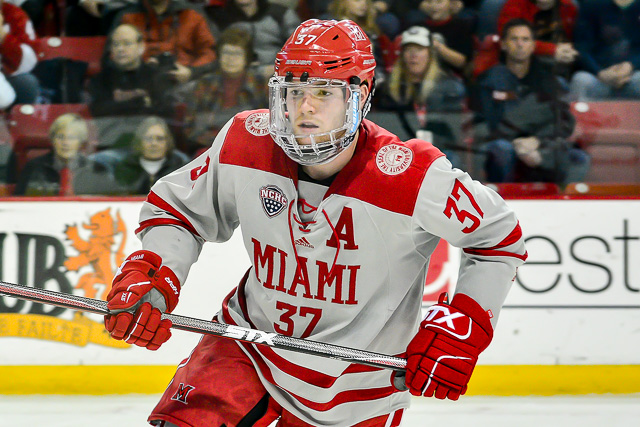
Miami’s Josh Melnick (photo by Cathy Lachmann/BoB).
Senior co-captain Josh Melnick said the energy the duo has brought to the program has been contagious.
“They’re obviously two younger guys and they bring sort of a different perspective to the locker room,” Melnick said. “As a whole, they’ve settled in really well, and I think they’re getting a good feeling of what our program’s about and also helping re-establish the things that we want to work on to get the program back to where it was in the past.”
Miami’s roster, which was not completed until late July, features five new forwards, four on defense and two in net. Two of the 11 are graduate students completing their fourth years of hockey eligibility.
“I think we’ve brought in some guys that will know their role – they were recruited to it,” Blasi said. “I think they’re a little bit older, we’ve got some Clark Cup championship-caliber players who have been through it, understand how to win a championship, guys that have been captains on their teams, and we have one (Jonathan Gruden) that played on the U.S. Development Team, played in the Worlds, and played with (the forward) that’s probably going to be the first overall pick in this (2019’s) NHL draft (Jack Hughes) and played on the same line with him. These are all positive things, and then you add two postgrads to the new faces, and we’ve got guys that are real positive and a tight freshman group.”

Grant Hutton (photo by Cathy Lachmann/BoB).
Both Melnick and defenseman fellow co-captain Grant Hutton love what they’ve seen from the newest Hawks.
“I think it’s everything we’ve expected and more,” Hutton said. “A lot of these guys are a lot of key, role players that know they’re here for a reason. You see it a lot in college hockey where guys may be goal scorers or big points guys in juniors or whatever it may be, and they get to college and they’re kind of shell-shocked. Gruden is our only true freshman at 18 years old and a lot of older guys that are coming in are mature, and I think that’s the biggest thing. Usually you talk about college hockey being a place where players have the opportunity to mature and develop, but it’s a huge plus when you get players that come in and have some of that maturity, some of that development. We’re pretty lucky with the group we have coming in, and I think it adds more excitement.”
Said Melnick: “They all assimilated right into things quickly – they’re all great people off the ice, and I think a lot of the reason we have high energy is because those guys have a lot of energy. They came here ready to work, and they know what the program stands for and what it’s been like in the past, and they’re ready to help get it back to that point.”
During the summer before the new players arrived, the returning players reached out to the freshman class to welcome them to the program, Melnick said.
The off-season didn’t start well for Miami. Within days of the RedHawks’ final game, it was announced that assistant coaches Brent Brekke and Nick Petraglia would not return as well as four players.
Two other prominent forwards also left the team early in the off-season, with one turning pro and the other transferring.
That’s on top of Miami not qualifying for the NCAA Tournament or even making it out of the NCHC quarterfinal round for the third straight season after qualifying for 10 of the previous 12 national championships.
“This is something that, I don’t look at this as a job, this is my life,” Blasi said. “When your life isn’t going the way you think it should go in terms of guys not playing up to their capabilities or even some of the things I might’ve done in the last couple of years that were wrong decisions. You assess, you evaluate, you try to be better – we all have opportunities to be better every day, we’re no different and I’m no different – and if I told you I wasn’t frustrated or disappointed in certain occasions, I’d be lying to you. But I can also tell you that I’m very proud of some of the things that have happened in the past couple of years. I believe in my heart that these are necessary steps that need to happen to move forward and become better. When we built the program, we went through some tough times, but nobody talks about those because nobody remembers those, everybody just remembers the wins and the Frozen Fours and the championships. I can tell you there were times where we had the same frustrations, the same disappointments, but they were necessary disappointments and necessary things that we needed to get through to get to the next level, and that’s what we’re going to do right now.”
Some positive things happened this off-season well. Multiple prior Omaha recruits switched to Miami following Mannino’s hiring, including defenseman Derek Daschke.
“Obviously at first it was a little difficult with having to (deal with) some difficult situations, to be honest with you,” Blasi said. “Once we started to kind of shape our team around the guys we have coming back, finishing off the recruiting and finishing off the staff, and getting together as a staff and kind of formulating our plan and getting to know each other on a different level, and then obviously have our team come back and work with them and kind of creating their identity. It’s been a lot of fun. ‘Reenergize’ is a work that we’ve been using a lot lately.”
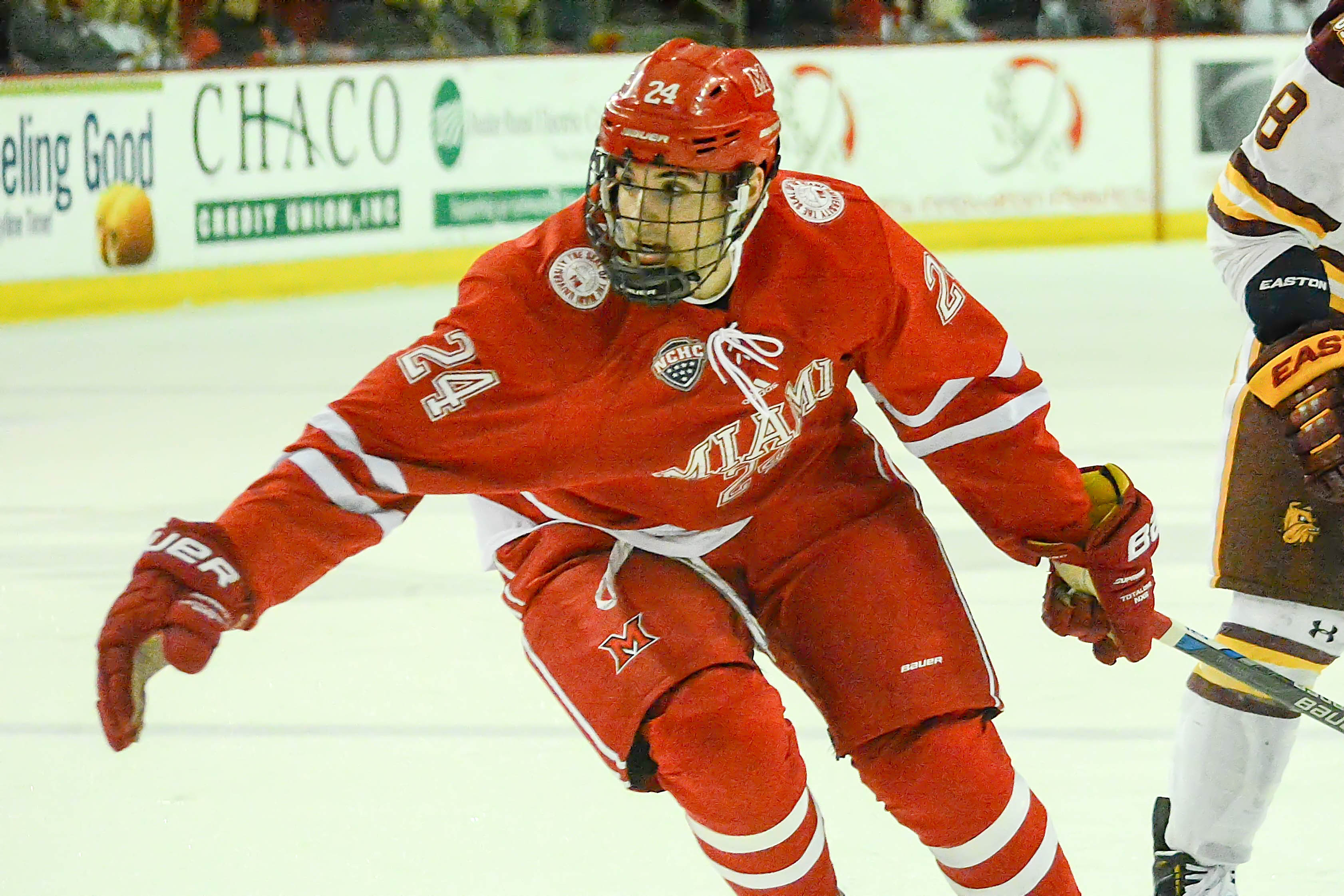
Miami’s Ryan Siroky (photo by Cathy Lachmann/BoB).
And both Melnick and Hutton, both seniors and destined for lucrative professional careers, announced they were returning this fall.
“I give Hudson, Melly a lot of credit, them and the senior class – Lavs (Zach Lavalle) and (Ryan) Siroky – that helped shaped the spring and the summer to make sure when these new guys came in, that our program was in a good place and we were going to hit the ground running.”
Miami played some quality hockey down the stretch last season, and Blasi said his team will seize that momentum and carry it into this campaign.
“Those are some of the things we were really proud of,” Blasi said. “To stick with it and to keep fighting, that’s a character trait that you can’t teach. And that’s something that’s in our locker room, that’s something that’s in our culture. I was very, very proud of the team and the way they played. Now, do we want to win at the end? Of course. Everybody does. But at the same time, you have to take a step back and assess the situation, and I believe that how we played was really important for the guys coming back in the spring and the summer and for our recruits, to say hey, we’re not that far off. We just need to maybe work a little harder, improve one or two percent. If everybody can do that, then we have something. When you’re in the moment, it doesn’t seem like it, and I know it probably doesn’t seem like it to the general fan – and we have great fans and great supporters, some of which have expressed their support and some of them haven’t, and that’s OK too – but when you take a step back and you see all the developments that have happened over the past couple of years, I think you’ll look back and say, hey, maybe if we didn’t go through that we don’t get to that next level.”
He pointed out that Miami was ranked as high as No. 14 in the PairWise after its big January home win over powerhouse Denver.
“It just shows that we have a group that isn’t rolling over, we’re not going to quit,” Hutton said. “We’re here because we want to be here, we’re here because we love each other, we love Miami, and we want to be the best possible hockey team that we can be every single night and ultimately reach our goal of bringing a championship back to Oxford.”
Blasi said that he, as well as both assistants, have been actively involved in recruiting this off-season and has hit the road with one or both on several occasions as Miami tries to fortify its roster for the coming years.
“I think the culture of the program is still very strong in terms of what we believe in and the way we do our business from day to day,” Blasi said. “We may tweak some things here and there but I think The Brotherhood and the family and the relationships and the process is still something that we still focus on, it’s still all about developing these young men to play at the next level or develop them to be better people on a day-to-day perspective. But at the end of the day, recruiting is your bloodline – that’s never going to change – and so recruiting is very important, and our team is very important. We have to make sure we’re focused on both equally and we’re doing what we need to do to help these men that we have get to the next level and win games and play at a high level, maybe reach levels that they thought they couldn’t reach. That’s part of what we do as coaches is inspire them and push them in a good way to make them play better than even they think they can.”
Though the season doesn’t start until Saturday, Melnick he noticed a marked difference in the locker room already.
“A lot of the times when people ask what’s most exciting about this year and what’s different, I think it’s the energy, and it’s just coming from everyone,” Melnick said. “It’s honestly kind of crazy to be around, because everybody’s so positive and confident and we just can’t wait to get out there.”
Check back for a positional breakdown of the RedHawks.

Q&A with associate head coach Mannino
He was the starting goalie during Denver’s 2005 NCAA championship season and played six NHL games before turning to coaching, and behind the bench he has already won a Clark Cup title in the USHL as an assistant with Chicago.
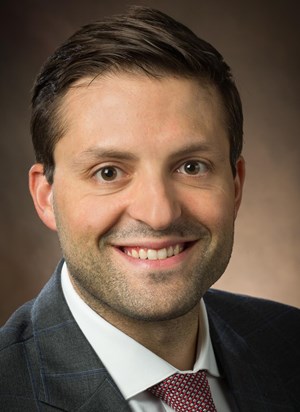
Peter Mannino (used with permission of Miami athletics)
On March 29, less than three weeks after Miami relieved both of its assistant coaches of duties, Peter Mannino was hired into the associate head coaching role.
Mannino moved to Oxford along with his wife, Alyta, daughter, Sienna, 3, and son, Luca, 1.
BoB: You were named associate head coach this off-season, so what would you want Miami fans to know about you from a coaching philosophy perspective?
Mannino: I’m a very approachable, honest coach. One that really dives into the experience I had when I played. I try to bring that to the table because I never want to forget those days. My brain is at the same level as what they’re going through. That’s just the way I approach things, the way we ask (the players) to every day – be honest, work hard and be approachable, have a two-way communicative relationship. That’s what I really, really want the players to know, is that we care about them. We’re here to push them, on and off the ice, take care of them when we need to, push them when we need to and make them earn everything that they’ve deserved up to this point. Kind of all those little attributes, those words kind of pile up together and that’s the way things go with me and the players.
BoB: You played at Denver and have coached at Nebraska-Omaha, so you seem like a perfect fit at Miami in terms of a coach who understands this conference and these teams’ styles as well as the type of player teams need to recruit to win in this league.
Mannino: Absolutely. It was the same way when I played – I played in the USHL, I played junior hockey, I went through the different steps and levels, and what I’m really excited about is I was able to coach two years in the USHL with the Chicago Steel and work my way up. Because you see those players define their levels of college or next step in life, and I went through that for several years. I had a lot of success my second year and I was able to distinguish that level change for (those players) as they developed and when I went to UNO last year, first hand I was a part of it, from practicing to recruiting to game-like speed. I’m very familiar with the NCHC, which is so identical to the old WCHA when I played.
BoB: Stepping back to your NCAA career, you were in net for every game of Denver’s title run in 2005 culminating in a Frozen Four played at Nationwide Arena in Columbus. Can you reflect on that experience, winning a national championship as a freshman?
Mannino: Obviously the cliché: It was special. It was kind of unique too because (Denver) had won it the year before. So when I went in everybody was like, oh, you jumped on the bandwagon. No, no, no, I committed before they won, so actually we had a bullseye on our backs. We had to play honest every night because people wanted to get us. We were the defending champions but really it was kind of awkward because our freshman group wasn’t a part of that, but we were meshed into it. So it was really unique to be a part of a very special time at Denver hockey where they had just won – and it was an iconic Frozen Four – to then step foot into my position, there was a lot of what could’ve been looked like as pressure.
But our group from seniors to freshmen, we meshed right away. We pushed each other, we held each other accountable and it just showed, game by game all the way to that championship, we all relied on each other and we all needed each other, it wasn’t just (Paul) Stastny, it was Matt Laatsch our captain – it was awesome. You have to have a team approach to win in the NCAA because it gets so hard, so tight, and one goal can change your career. It’s an eternal memory that I am obviously am very fortunate to have from when I played and moved on to play professionally, but now as a coach I cherish those memories because I can dive into those and talk to guys about them and hopefully help them.
BoB: Your 2005 run is quite a story, because your dominant final stretch that postseason was preceded by a pair of games in which you allowed five goals each. You then posted three straight shutouts and obviously went 4-0 in the NCAA Tournament. What turned you around so quickly that season?
Mannino: It’s that freshman year, right? You go into it, it’s a new team, new feel, new level, and my game was adjusting. I had ups and downs – I remember my first game getting pelted by Boston College then turning around and playing Wisconsin and having a really good win on the road. That’s what I tell the guys – you’ve got to use those (struggles) and get through them, and it’s the big picture. Just like you said: No one looks at those back-to-back five-goal games, but that was my journey. I needed to embrace that and get better and over it, and then in the end you look at the big picture and (the title) was the end result. You were just asking me about that year and the first thing I think of is the ups and downs. We had a tough start, we played some games in which we struggled as a team but those struggles are so important rather than just the back-to-back (titles). We needed to struggle to get to that point, to stay the course at the national tournament, so yeah, that was part of the journey.
BoB: For those like myself who grew up dreaming of playing in the NHL but lacked the necessary talent, you made it to the NHL and played six games. What do you take from that chapter of your life in which you were able to play hockey at the highest level, albeit for a brief time?
Mannino: A dream come true. Everything you do from when I was went to that first NHL game I wanted to be in that arena, be part of that crowd, and I remember telling my third- or fourth-grade teacher that I want to play in the NHL. That was my goal. The thing you learn is just how hard it is to get there. You said I played six games, but I was up for 50 games. No one ever knows that, but it’s so hard to get there, and then to play a game – guys get called up and sit around and they never get that shot. It is so hard but that’s what it’s so special, because of that, and it’s the group and the teams – everything around you from your parents to coaches to opportunities people give you. I could spend hours telling you: This guy believes in me, this guy believes in me, this guy called me and let me play here, this guy allowed me to get seen here. It’s all about finding people that you trust and taking advantage of opportunities. I did that for the most part and that’s what got me six games, but I’m fortunate for everything – I’m thankful to my parents, I’m thankful to every coach, every teammate, every team that I was a part of, because everybody played a part of it.
BoB: You were a coach at Omaha, and the Mavericks have been slightly better than Miami in recent years, so what was the hook that brought you to Oxford?
Mannino: You and I know and we have this conversation with so many people that last year, from where we were at Omaha, (we could’ve finished) anywhere, 4-through-8, the last few four weekends, and it was very stressful. In Omaha we were able to piece together a nice little finish there with some splits and some wins. The boys dug deep, we had a nice senior class, everybody played a big part of that, and we were able to stay in that mid-pack, and unfortunately Miami kind of flipped, right? That just shows you how special our conference is. In any given year – three years ago Miami won the NCHC. There’s so many differences in the year-by-year.
For me it’s not about that, it was more opportunity, relationship-based: Rico Blasi the head coach and one of the founders here, George Gwozdecky, was my coach at Denver. So when I played in college, which is a special part of anybody’s career, when you’re there for four years, it establishes a culture, a mindset and just a belief in coaching and the whole philosophy. I’ve gotten to know Rico over the years, I know Jeff Blashill, I know the whole group that sort of mingles with George Gwozdecky, Rico and myself. There’s a trust – there’s a circle that you really know.
So when things kind of finished up and I received a call from Rico, it was not like talking to a person for the first time, it was listening to a person who was offering up an opportunity that was incredible. The history here – 20 years that Rico has been at Miami, he’s been to the top. What he’s built here, the Brotherhood, everything about it is so special. I’ve played with Andy Miele, players like that, that are part of the Brotherhood, I’ve seen it firsthand from an alum in the pro levels. Played in the game here, you know that game Denver vs. Miami (in the Ice Breaker to open Cady Arena in 2006), that was me, I was in that game. So I wanted to work under and with somebody that’s had such a special coaching career and players can attest to that, the success of the program. I wanted to be a part of that, and that was a special thing to get offered that and to be a part of (this program) here today with Miami.
And obviously that goes along with the school, everything from our AD to the president. This is such a beautiful campus, this whole setup, to live here with my family in Oxford – I’m from Michigan, my wife is from Illinois – you have that kind of hockey side of it and you have the personal side of it, and it just lined up, it made sense. I had to go through the process myself which was very tough because Omaha was a special place, great people – same thing, from ADs all the way down. But it was the right choice, 100 percent, this is where I needed to take that step and I’m very happy and very fortunate for this opportunity.
BoB: You mentioned you were the goalie for Denver in the first game at Cady Arena. As I recall, Miami won that game.
Mannino: Yeah, Rico sticks that to me every time. 5-2, I didn’t play very well, I probably overhyped the game because of all of the fans and the crowd and the students in the front of the building – I saw them while I was stretching. I hear it every day and every recruit hears it here too. But like it or not I’m kind of a part of the history here, and that kind of holds a special place because I didn’t play here but I did get a chance to play here, against them and feel the environment first-hand, and I think that’s an important piece to have when I talk to the players, to recruits coming in, is that I actually did play here, I know what this is like.
BoB: You were hired in late March, and coaches and players were leaving left and right, then Miami was still piecing together its roster this summer, so how tumultuous has this off-season been as you transition here?
Mannino: It was similar with Omaha, I think we had 10 or 11 players coming in – it’s the way it goes any time there’s change. When there’s change, you bring change because it’s time to kind of hit reset. There’s tough decisions, there’s players that move on. But in any of those situations or any losses that happen, a (Kiefer) Sherwood leaving early, losing a four-year player like (Louie Belpedio) and just other players moving on, it’s part of it. That’s the way things are today in college hockey. It’s a very, very quick-changing game with freshmen leaving, sophomores, people leaving just because they want to move. It’s a very loose field today, and it’s okay – that’s what we’re here for as coaches is to understand, players that sign early, move onto other places or can’t afford it, whatever might be.
This is a life here, it’s not just that you’re going to play hockey. There’s money invested, not everybody’s on a full scholarship, there’s so much stuff that happens. I understand that, Rico understands that, (assistant) Joel (Beal) understands that – that’s part of it, it’s forever changing. We’re thrilled obviously – like you said, there were a lot of changes that needed to be made and gaps that we had to fill – and we’re really excited about that, bringing in a lot of experience, a lot of great character personalities and success levels before they got here. That’s what we do, we’re piecing it together. I was in the same boat last year and everybody does it because you lose a lot of players because (college) is a level where players are moving on.
BoB: You were hired on March 29, and at that point most potential recruits’ seasons were winding down. So what has your primary focus been in the months since you accepted this position?
Mannino: Initially, (Miami’s) season was obviously over, so I got to fly in and sit in on all the end-of-the-year, start-of-the-spring-season meetings. So I got to listen in on a lot of guys talking about where they were, where they wanted to go. We broke it down as a staff. That was very crucial.
I know a really good amount of (Miami’s players), either coaching against them, USHL…I have a pretty good feel for most of the guys. Obviously I watched tape to get a good feel and then was just able to catch up in different sessions.
You already know them, you pre-scouted against them last year and obviously coached against a lot of them when I was in the USHL so I have a good feel there. As a coach, as a recruiter you have to understand what you’re getting into, and I knew right away what I was getting, what you inherit as a group.
That was a big thing because now it shifts to when I was hired, it was recruiting, getting to know the committed players, verbally and signed players. I got to know them right away. Get out there and see them if I haven’t – which is probably 90 percent of them anyway – and start the work for Miami right away. What are our holes, what are our needs? And we did that: We brought in defense, we brought in forwards to add depth in every area. With (goalie) Jordan (Uhelski), bringing a nice little competitiveness in the back end, that was the idea is making sure we’re hitting on all of our needs.
So that was kind of it off the hop: Identifying the current, identifying the future players and then going after them from a recruiting standpoint. Rico and I hit the road a good amount and then when Joel came aboard all three of us were running. And then it was sit down, strategy, plan out and kind of prepare from there.
Now we’re in practices, myself and Joel are working the penalty kill, working the goalies, working the systems. It’s a constant group effort, which is a big reason I wanted to come to Miami from the coaching side.
BoB: How difficult of a situation is this to come into, with Miami having not gone to the NCAA Tournament three straight years after a long run of success?
Mannino: Yeah, I think that’s it. We will see a different approach, a real good team approach, a hard-working, really good-skating, better mindset of defending. We’re going to see a really good goalie performance, whoever that is – I know Larks (Ryan Larkin) has carried the load here, and Jordan’s going to come in here and push which is all good competition. And we can say that throughout the lineup because we have depth. We’ve added pieces all around. We’ve added three Clark Cup (USHL) champions, you’ve added guys from the U.S. National Team or USHL, and those are pieces that are very, very important because that creates that culture and that championship mindset that we all want.
Knowing (defenseman) Derek (Daschke), we won with him (in Chicago), and that’s the mindset of all of our players is you know that they can come in and contribute right away in all areas, up and down the lineup. And that’s all you can ask for is experience like that and maturity.
So I think we’re going to have a very good year. It’s a stepping stone, every year, you wish you had one more here, one more there, but once again, that’s the way it is in college. Every team is looking at their board and they’re not complete. That’s just a fact.
BoB: You mentioned Derek Daschke. He is a highly-touted defenseman who was committed to UNO after playing for you in Chicago but switched to Miami this off-season after your hiring. He has a solid reputation and a two-way blueliner who can score, move the puck, run a power play and defend well. Can you talk about him since he’s a player you’re so familiar with?
Mannino: I know a lot of the guys, like Karch Bachman I coached in Chicago, recruited Bray Crowder, recruited Scott Corbett, recruited Monte Graham. I coached against (Phil) Knies when we were in the Clark Cup championship. It goes on and on and on. So I’m very familiar – this isn’t just one player. I know Larkin when he was in the USHL, I watched him in all of those festivals. I’ve seen all these guys, give or take a handful. (Derek) would be that mature, junior-experienced player that has had success and has gone through the gauntlet and prepares for it. His mindset is just like our other freshmen and sophomores moving forward, we feel like across the board we have a group that wants to be a group.
BoB: It’s been fun watching Karch Bachman get better and better, as he started finishing those chances toward the end of last season.
Mannino: You can say that about all of them, right? Everybody that’s still here is here to develop and continue to work toward that next level, and if not they’ve moved on to other levels or they’ve graduated. Kind of the fun part about college: It’s a very developmental stage. These guys have holes in their game that they want to work on every day and they have those strong attributes, like Karch can skate, he can shoot the puck, so what do you do with it? He’s been great – he understands it, identifies it and attacks it. Go after it, get better.
BoB: The former assistants had specific in-game roles, like Coach Brekke handled the defensemen. Being a former goalie, will you handle the netminders, and do you and Coach Beal know what your duties will be once the puck drops?
Mannino: Defense, PK, Joel and I will be working hand in hand in those areas, because if one of us is on the road we want to be up to par there. Obviously the goalies are a special nook – that’s one thing I’m going to be working with every day.
What I will say is going into it with Rico is he’s been awesome and receptive, asking Joel and myself whatever it is. We’re open on all cylinders here, drills, practice flow, plans for scheduling – that’s the fun part is learning under Rico and all contributing in all different ways, because that’s what we ask our guys to do. I think it’s a productive environment behind the scenes that we can all be on the same page too.

Q&A with assistant coach Joel Beal

Miami assistant Joe Beal (used with permission of Miami University athletics)
Joel Beal was named Miami’s assistant coach on June 2 after five seasons at Sacred Heart, three as an assistant and the final two as associate head coach. He recorded 101 points in four seasons as a playmaking forward for Union and coached there for two seasons before joining Sacred Heart.
Beal moved to Oxford along with his wife, Jessica and his daughter, Mackenzie, 3. His son, Parker, was born on Sept. 4.
BoB: Coach, first of all, welcome to Miami. What would you want Miami fans to know about your coaching philosophy?
Beal: I think when I went through the interview process with (Coach Blasi) and (Coach Mannino) here a couple of months ago, we talked a lot about my coaching philosophy. As an assistant coach I think I have two roles within our staff here, and that’s to recruit the best possible players to Miami and then once those student-athletes get here to help them develop. I think that’s a huge piece of being an assistant coach is helping our players develop to play at the next level and to become great people, great hockey players, great students. Any way we can assist them whether it be through coaching, through video, through skills, even just lunch, breakfast, just being an ear for those guys, really being a support system for our players in key. And the way we’re going to do that is a lot of communication and make sure we have great relationships and work ethic. Those are the three things that I’m going to focus on here in terms of helping our players develop. And then obviously the recruiting piece is huge, being an assistant coach.
BoB: You grew up in Brantford, Ontario, and obviously anyone who knows hockey knows that’s the hometown of Wayne Gretzky. During your playing career did you find expectations on you were higher because you hailed from the same place as the best player ever to play hockey?
Beal: Not really. Any time I introduce myself I and they ask where you’re from and I say, Brantford, Ontario, and immediately they say, oh, isn’t there a famous hockey player from Brantford? (I say) absolutely, and that’s come up, and it’s a great topic of conversation with recruits, with families. Growing up in that town – it’s obviously a big hockey town – I played minor hockey at the Wayne Gretzky Sports Centre which is on Wayne Gretzky Parkway, and I played in the Wayne Gretzky Tournament at Christmastime. And Walter (Wayne’s father) is always at the rink. They’ve actually changed the name – it used to be the Wayne Gretzky Tournament, it’s now the Walter Gretzky Tournament because he’s the guy who’s there, who’s handing out the certificates and the trophies, signing autographs, doing all that stuff. My whole family’s from that town, my dad grew up there, he’s got five brothers and one of the brothers is the same age as Wayne, so my grandmother used to be able to go to Wayne’s baseball games in the summertime as well as the hockey games in the winter. She was close with Walter all those years, they’d say ‘hello’ at the rink…so it was pretty cool growing up in that town. But in terms of expectations on me or future hockey players, not really. There’s only one Wayne, right?
BoB: Has your path ever directly crossed with Wayne in your lifetime?
Beal: Yeah, once – and this is going way back – might have been the NHL lockout in the 90s. He was off for a couple weeks and he just showed up at the rink, and immediately, all in the sudden the rink was packed with people. His dad was still working with the team, and he jumped on the ice with the guys and he was in and out of town in like a half hour, but that was the only time our paths have actually crossed. Again, Walter is the guy you see around Brantford.
BoB: So you played at Union and racked up 101 points. You have the best single-season assist total in school history with 29 and are second all-time in career helpers with 74. Any time someone has 100 points in the NCAA it’s a great career, so can you talk about your NCAA playing days?
Beal: Union was a great spot for me because it brought – similar to Miami – a great academic tradition and history. That was really important for me. I wanted to make sure I was getting a good degree, I was a mechanical engineering major at Union, so that aspect was very important. At the time when I went to Union they weren’t as relevant on the national stage as they are today, so it was a good fit me for in terms of getting in and getting those opportunities to play. I got to play for two great coaches, who, 18 years later, are still coaching today. Kevin Sneddon, who’s (the head coach) at Vermont, recruited me to Union, and two years into my Union career he took the job at UVM, and Union hired Nate Leaman who has since moved onto (the head coaching role at) Providence. I was really lucky in that I got the opportunity to play for two great coaches and I got to learn from them. Two different experiences. I find myself in my coaching life very lucky to have played for two guys that are very different but also very successful in their own right. I think the on-ice experience was great for me. (Union’s) a great school and a great place and I do so a lot of similarities between Union and Miami in terms of the education and the athletics.
BoB: You were officially named assistant coach here on June 2. Can you talk about the process that lead to you landing the job here?
Beal: I didn’t have a previous relationship with either Rico (Blasi) or Peter (Mannino). Peter had been hired pretty quickly after the staff changes were announced, and two or three weeks before the coaches’ convention in Naples (Fla.), which is in April every year following the Frozen Four, I put in a call to Rico, I left him a voicemail to let him know that I was interested in the position and I was looking forward to hopefully hearing back from him. Rico was busy – he was doing a lot of work at that time before the coaches’ convention. The season had just ended and he was putting together a staff, and we ended up meeting for the first time in Naples. We had a conversation over coffee for about an hour and just kind of got to know each other and he got to pick my brain a little bit and I got to pick his brain a little bit. That was a really good conversation. I wasn’t sure where it was going to go from there, and then about a week later I had a phone conversation with Coach Mannino, who was somebody else I hadn’t met before. So there really was no previous relationship or previous history between the three of us. And it was just a series of phone calls and conversations that I thought were really positive, and I thought what they were trying to build here, I could be a good fit. It’s obviously about a fit – you want to be able to build your staff so that you have certain people that are able do certain things to really fulfill all of the jobs that we need to do here. That was going really well and I think Rico had some relationships with some coaches that I had played for before or worked with – I know him and Coach Leaman at Providence talk a lot and they value each other’s opinion, and I think Coach Leaman was willing to make a phone call to Rico and kind of put in a good word for me – I think that went a long way. Two or three weeks after that I was on campus for an interview. I loved it, I loved everything about it. The philosophy, The Brotherhood, the culture, the facilities, the school, the town, it all was really a good fit for my family and Rico offered me the job a couple days later. I think I wasn’t off the phone for an hour, I called my wife and I called him back and said we’re in.
BoB: Before that interview had you ever been to Oxford?
Beal: I’d never been to Oxford, no. So in reality it was a cold call from me to Rico that got the process started. It just so happened, and this is in life, any time that you’re trying to get a job, that there were some people that I knew that were willing to really put in a good word to Rico for me. And I really think that went a long way in terms of us not having a previous relationship. There are some people that he really trusts in the hockey world that I had known and had relationships with – Coach (Rick) Bennett at Union and Coach (C.J.) Marottolo at Sacred Heart – Rico knows those guys and those guys have all been around a long time, and the hockey world is small, so I think that really helped. And I’m very grateful to those guys that they were willing to help me out.
BoB: You didn’t get hired until the beginning of June, so what have you been able to do in the 3½ months since you’ve been hired at Miami to prepare for this season?
Beal: We’ve been really focused on recruiting. Peter and I have talked a lot about players that we both know. Players that I might know he might not know. What are needs are going into the future. We’ve watched a lot of video, both on recruits that were committed by the previous staff, so the guys that are coming to Miami that maybe I wasn’t as familiar with, and I think that’s really important is to understand what we’ve got coming in. We’ve been watching video on our current team because I think that’s important to have an idea of what our needs, what our holes might be as we look forward to the future, and then obviously there were a lot of phone calls that I had to make with some recruits and some prospects that I think might be a good fit for Miami in the future. There wasn’t a lot of crossover in the recruiting that I’d done at Sacred Heart with the recruiting that we’re doing at Miami in terms of the player pool – it’s a different player pool. So In think for me it was a lot of catching up with the player pool that we’re targeting. I think it’s a more elite, younger player that we’re targeting at Miami than I was previously at Sacred Heart. I’ve been trying to do a lot of homework in that aspect as well, and besides that getting my family moved out here to Oxford. It was a quick turnaround: I had to sell a house, buy a house, my wife was actually pregnant – she just gave birth (on Sept. 4) – so she was like seven months pregnant when we moved out here. I had to get the doctors and the hospitals sorted out on that side as well. But Rico and Peter are just amazing in terms of making sure that the family’s taken care of and family first. And it’s not just something that we say to our team – family first – the Brotherhood here and the staff embodies it and they put into practice, and I had first-hand experience with that from Day 1. Those guys were awesome.
BoB: Miami had a run of success with players from Chicago and to a smaller degree from Columbus, and recently it has taken on a more Michigan-centric feel. Being from Canada and having coached on the east coast, do you see this team taking on players from different regions than it has in the past?
Beal: A little bit. At Sacred Heart I’ve done a little more work in the Ontario loop – both the Toronto area and the Ottawa area – and then in British Columbia. I think we’re going to target some of those areas. We’re going to target areas where we think we can get the best possible players, and those are some areas that have produced some good players not only in our league but across the country. I did talk to Rico a little bit about the recruiting process, and some of the recruiting that I’d done in Ontario and British Columbia and Alberta and some of those places, and the lack of presence of those areas on the current roster was something that – hey, let’s look into that, let’s see why we haven’t been able to get some of the top players out of those areas and let’s go to the well and see what we can do.
BoB: Miami has a solid history in all of those spots, as Dan Boyle (Ottawa), Curtis McKenzie (Golden, B.C.) and Reilly Smith (Toronto area) have all worked out really well for Miami.
Beal: I have a few relationships with some of those (juniors) coaches and just like anything it’s all about relationships and knowing some people. I think that will help a little bit but in the end we’re not going to say ‘no’ or say ‘yes’ to anyone just because of where they’re from. We’ve done pretty good in our own back yard – Michigan, Ohio, Indiana, Illinois – and we need to make sure that we’re actively targeting those players in our backyard, but after that, yeah, let’s go find the best.
BoB: You’ve been a Division I assistant for quite a while. I remember just a few years ago it seemed like players weren’t allowed to interact with coaches at all until the week before opening night. What has changed in recent years from an NCAA perspective in terms of handling players?
Beal: In terms of the actual coaching, the NCAA has bumped it up from two hours to four hours a week for our on-ice skill instruction. So basically in the past those two hours were broken up into three 40-minute sessions – three practices a week – where now we’re able to go four practices a week at an hour long. There’s certainly a lot more involvement on ice, coaching our players in September, and hopefully that’s going to better prepare not only us but every team in the country and you’ll see a lot higher quality (play) in October, which is what everybody wants. I think it’s definitely been a benefit.
BoB: How about the dealing with recruits prior to the season?
Beal: One thing that’s changed is every league will basically have their showcase in September. All that means is they’re going to bring in all the teams from their league into one city and they’re going to play a series of games back-to-back. For us, as coaches recruiting, if we’re able to fly into Calgary or Toronto or Pittsburgh for two days and see 12 or 14 teams to give us a really good base of knowledge on the league, the teams and the players going into the season going forward. One, it saves a lot of money because you’re going to see a lot of teams in a quick weekend, but two, we get a really good feel for the leagues and the targets going into the season so that we can be a little more active and pinpoint who we want to be, who we want to (pursue) going into the year. Those showcases – every league does it now – so it’s just a matter of spreading ourselves out and using our time wisely and making sure we’re hitting all these leagues and all these teams and targets in September so that we’re ready to go when the season starts. Because when our games start, it’s always a little harder to get out and to be seeing as many players because a lot of these leagues are Friday-Saturday leagues as well.
BoB: How tough of a situation is this to come into? RedHawks fans were accustomed to annual NCAA berths and now the team has a .399 winning percentage the past three seasons and expect an immediate reversal, and yet the players you’re inheriting aren’t guys you recruited.
Beal: Me personally, I love the expectations. I think that having high expectations means you have a history of tradition, a history of success and you have the support of the institution, the administration to help build that success. For me personally it hasn’t been tough at all. I think it’s a terrific group of players that we have in the locker room, I think our culture’s outstanding right now, I think our work ethic’s outstanding and I think our team is genuinely excited to get on the ice and to play that first game. I think they really want to see what we have because we feel really good about it right now, which I think is a great start. Obviously we’re going to hit adversity at some point, we’re going to battle through some adversity like every team does, but I think we have a really strong culture in place right now, and we’re going to see the success and we’re going to see the results and hopefully we can live up to those expectations. Peter and Rico and I, we’re not coming into the season thinking these aren’t our players, it’s a rebuild time. We’re going to work every day to have success, that’s our goal.
BoB: Last season Miami seemed like it was close to being a contender in the NCHC but fell just a little short, and they seemed to lose a lot of close games. You’ve seen enough film at this point and know the guys well enough, so at this point what do you think this team needs to do in order to flip some of those losses to wins?
Beal: I think you’ll see that throughout college hockey is that it’s tight, and especially in this league there’s a lot of parity, there’s not a lot of difference from the top of the league to the bottom of the league. I think when you look at any league and you look at the teams at the top and the teams at the bottom, the two things you can look at are your special teams and your goaltending – you’ve got to be great in those two areas, and those are two areas that we’re going to focus on. If it’s a 3-2 game, you get another goal on the power play or your penalty kill keeps one out, that’s the difference between winning and losing. I don’t think I’ve given you any super-secret methodology of how to be successful, that’s a tried-and-true formula and recipe for success not only in our league but any league. Hopefully we can be great in those areas because I know our work ethic and our culture and our attitude is great.
BoB: Coaches Petraglia and Brekke both had specific in-game responsibilities. Coach Mannino was a goalie and you were a playmaking forward, so do you know what your specific game-night coaching duties will be?
Beal: We haven’t talked a lot about that yet up to this point, so I don’t really have a good sense. I can tell you right now Peter and I have working a lot with the penalty kill. We’ve trying to have that ready for the start of the season. We’ve been spending some time – Peter, obviously – working with the goaltenders, and that kind of goes hand-in-hand with the penalty kill and we’ve been working with the defensemen. That’s kind of what we’ve been focused on. Moving forward, in terms of game-day responsibility, I don’t think that’s something that our staff has worked out yet. We’re just trying to get our team ready for that point.
BoB: The NCHC is arguably to best league in Division I, and as a result the annual conference schedule is brutal. How does a coach help prepare a team for such a difficult slate of games and how do you keep the players focused throughout?
Beal: We focus on really setting a standard of how we want to practice every single day, and we’re not looking too far ahead – I know it’s a cliché, but we’re going to take it day by day here – beyond taking it day by day is we want to set a standard for our execution, our work ethic every day in practice. That’s kind of the first step we’re focusing on. In terms of having a murderer’s row, we’re going to trust our process for how we’re going to go about doing things. How we’re going to prepare, what our work ethic is going to be and how we’re going to execute. And if we go into every weekend, every game with a focus on how hard we’re going to work, and we’re prepared and we’re going to execute…we’re going to have success. And again, it’s going to be about managing some of that adversity and controlling our emotions and not getting too high and not getting too low because there’s going to be good nights and there’s going to be bad nights, but I think if we’re focused on trusting the process, setting that standard every single day I think we can have confidence going into every weekend that we can compete, and we’ll see what the results are.
BoB: Even though you weren’t here last season the team finished well and took Duluth to overtime in Game 3 of the NCHC semifinals. In your limited time with limited exposure to the players do you think that somewhat positive ending to 2017-18 will carry over to this season?
Beal: Yeah, I think so. It’s a really strong leadership group we have in the locker room. (Grant) Hutton and (Josh) Melnick – terrific captains, terrific leadership and I think they kind of saw at the end of last season what we could have going forward to this year, and I think that’s part of the reason they decided to come back for their senior years – they obviously had some options to sign but they decided to come back because they had something to prove and they kind of saw what we had building in the locker room. And then I think we’ve got a lot of young guys – freshman to sophomore year is a huge year where a lot of guys can make jumps, you see some big gains from that freshman year to that sophomore year. We had some really good freshman performances last year, so we feel really confident about that. I wasn’t here in the spring, but talking to performance coach (Ben) Eaves and Rico, the spring workouts were phenomenal. So I think there’s been a lot of great energy and big growth and I think that carries over – to what you just said – some success the last two weekends and getting these guys coming back, great leadership group, we had a great spring, guys came back this summer, they’re training together, and then we’ve had a really good start to our fall workouts and on-ice sessions together. I definitely think there was a carryover from last year and I think you saw that with the leadership group deciding to come back and the great spring workouts that we had. We’re hoping some of that will carry over into the start of the season, and we’ll see how it goes.
NOTE: BoB will publish its interview with associate head coach Peter Mannino in the coming days.

Ten newbies on Miami’s roster
Miami entered 2017-18 with just three seniors, but its 2018-19 roster features 10 first-year RedHawks.
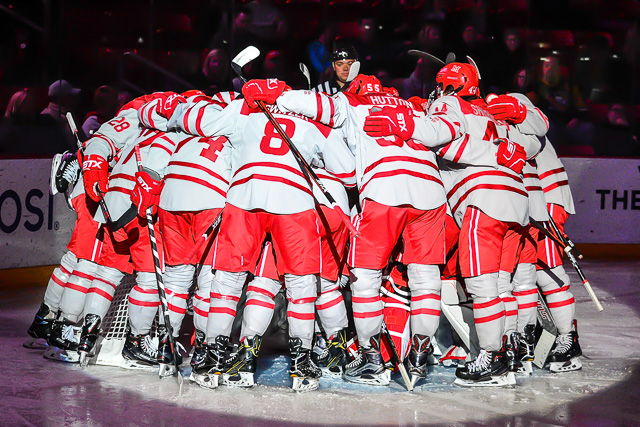
One is an NHL draftee – Johnny Gruden was selected by the Ottawa Senators in the fourth round last month.
Of the 10, five are forwards, four are defensemen plus one goalie. That brings Miami’s full roster to 15 wings and centers, nine blueliners and three netminders.
Two key names were missing from the RedHawks’ roster: Fs Matej Pekar and Ryan Savage.
Pekar was committed to UNO but switched to Miami this spring, following assistant coach Peter Mannino. He was drafted one spot ahead of Gruden, No. 94, by the Buffalo Sabres.
Since this is a sensitive subject that could negatively affect Pekar, BoB will not report any speculation about if or when he will join the team.
Savage, son of former NHL forward and RedHawks standout Brian Savage, signed an NLI prior to 2017-18 but will play another season in juniors after going 8-7-15 in 48 USHL games. He will join the RedHawks in 2019-20.
A glance at the newest official members of the Miami hockey community:
FORWARDS
71 JONATHAN GRUDEN
DOB: 5/4/2000.
Height: 6-0.
Weight: 170.
From: Farmington Hills, Mich.
2017-18 stats/team: USNDT, 61 GP, 28-32-60.
Notes: Gruden has the best credentials of any incoming player. He was drafted by Ottawa 95th overall in June and kept a point-a-game place for the USNDT and posted 15 goals and 19 assists in 25 games vs. USHL opponents.
His father, John Gruden, is a former NHL defenseman who logged 92 games over parts of six seasons with Boston, Ottawa and Washington. He is now the coach of OHL Hamilton, which makes Jonathan Gruden choosing the college path interesting.
In addition to his points production, he has impressed with his two-way play, and he also can play multiple forward positions. Coach Enrico Blasi really likes versatility.
Where he fits in this season: There’s rarely a sure thing in college hockey, but barring injury Gruden will almost certainly skate on one of the top two pairings this season and should excel.
The RedHawks will need his offensive talents, as six forwards from 2017-18 have moved on.
18 MONTE GRAHAM
DOB: 5/4/1998.
Height: 5-11.
Weight: 174.
From: Hanover, Mass.
2017-18 stats/team: Muskegon (USHL), 57 GP, 10-15-25.
Notes: The former Boston College commit (actually still on the Eagles’ 2018-19 roster!) is the cousin of former NHLer Tony Amonte and current Minnesota Wild center Charlie Coyle.
Graham has already played three full seasons in the USHL, logging 173 games and notching 21 goals and 36 assists. He is known for his skating, and he racked up 95 PIMs last season.
While he went from eight points to 24 in his first two USHL seasons, he climbed just one point to 25 in 2017-18.
Where he fits in this season: Not a big offensive guy in juniors, but Graham reached the 10-goal mark for the first time last season, so he may slide into a starting role.
Miami only has nine returning forwards, so opportunities for ice time should be ample for rookies up front.
14 NOAH JORDAN
Position: F.
DOB: 3/8/1997.
Height: 6-5.
Weight: 216.
From: Toronto, Ont.
2017-18 stats/team: North York (OJHL), 47 GP, 18-20-38.
Notes: Jordan played four seasons for St. Michael’s of the Ontario Junior Hockey League then was back in that league for his overage season in 2017-18. He netted 18 goals and dished for 20 assists in 47 games with North York and also tied for the team lead in playoff points with 12 in 11 games.
Jordan is 21, and only 20 Division I players are taller, according to College Hockey News. Originally a Quinnipiac commit, Jordan switched to Miami in April.
Where he fits in this season: The OJHL is considered a slight step above the NAHL, so we’ll see how that offensive success translates in the NCAA.
With Conor Lemirande graduating, a player exhibiting a similar style could be welcome for the RedHawks.
19 BRIAN HAWKINSON
DOB: 1/10/1998.
Height: 5-9.
Weight: 146.
From: Aurora, Colo.
2017-18 stats/team: Tri-City (USHL), 58 GP, 6-10-16.
Notes: Hawkinson has played the past three seasons with USHL Tri-City, where he was team captain last season. He was also teammates with Graham the duo’s first two juniors campaigns.
Known as a do-anything-to-win type, he enters 2018-19 with 164 games of regular-season experience in the USHL. He notched just 10 points in his first two seasons combined in that league, but he stepped up with a 6-10-16 line last year.
Tri-City lists him at 5-10, 175 while other sites have him at 5-9-146.
Where he fits in this season: Hard to say because smaller forwards are usually known for their offense and Hawkinson is more of a grit guy.
A ton of USHL experience should make for a smooth transition to the college game.
25 SCOTT CORBETT
Position: F.
DOB: 4/14/1998.
Height: 6-1.
Weight: 187.
From: Carmel, Ind.
2017-18 stats/team: Dubuque (USHL), 59 GP, 6-18-24.
Notes: Another older player with ample USHL experience, Corbett started his Major Juniors career in the NAHL but has been in the U the past season and a half.
The dual citizen committed to Miami last week, becoming the third player from the northern Indianapolis suburb to join the RedHawks in the past dozen years, with Cameron Schilling and Grant Hutton being the others.
Corbett was solid in his first full season in the USHL, going 6-18-24 in 59 games with Dubuque. He has good size for a forward competing in the ultra-physical NCHC.
Where he fits in this season: He hasn’t been a big points producer in juniors but Miami hasn’t gotten much production from its third and fourth lines in recent seasons so he may have the opportunity to thrive.
Again, with nine returning forwards, starting slots will be there for the taking so Corbett and the four other newbies up front should get long looks this fall.
DEFENSEMEN
13 DEREK DASCHKE
DOB: 1/6/1998.
Height: 6-2.
Weight: 190.
From: Troy, Mich.
2017-18 stats/team: Chicago (USHL), 56 GP, 8-21-29.
Notes: Peter Mannino was Daschke’s coach for Clark Cup-winning Chicago of the USHL this spring.
Daschke was committed to Nebraska-Omaha, where Mannino was an assistant, but when Mannino was hired by Miami this off-season, the blueliner switched his commitment to the RedHawks.
His commitment is definitely in the top five news items from this program this off-season. Daschke has played in the USHL since 2014 and he was the captain of that championship Steel team last season.
He has a laser of a shot and found the net eight times last season, adding 21 assists.
Where he fits in this season: It’s hard to imagine, barring injury, Daschke not contributing right away.
He’s big, he’s experienced, he can shoot the puck and he’s joining a team that has just five returning D-men.
4 ANDREW SINARD
DOB: 5/22/1997.
Height: 6-6.
Weight: 185.
From: Brentwood, Tenn.
2017-18 stats/team: Aberdeen (NAHL), 58 GP, 0-19-19.
Notes: Sinard is a shut-down defenseman with a huge reach, and he also picked up 19 assists last season with NAHL Aberdeen.
He started his Major Juniors career with USHL Cedar Rapids but has been with the Wings since. Sinard does not have a goal in 96 juniors games, but he has impressed with his shut-down prowess.
Where he fits in this season: The only two similar players in recent Miami history are Brian Sipotz and Michael Findorff, and neither were full-time starters, although Sipotz played six seasons with Chicago of the AHL.
We’ll see if Sinard can buck that trend.
3 BRAYDEN CROWDER
DOB: 11/17/1998.
Height: 6-6.
Weight: 201.
From: Sudbury, Ont.
2017-18 stats/team: Muskegon (USHL), 55 GP, 5-14-19.
Notes: Like Daschke, Crowder was also committed to Nebraska-Omaha but switched to Miami after Mannino was brought in as an assistant.
Crowder left Canada two seasons ago, and after staying in the NAHL in 2016-17, he jumped to the USHL and went 5-14-19 with Muskegon, finishing plus-11.
Miami will be his 10th team in six seasons, so the blueliner should welcome the stability. His father, Troy, was a tough guy who logged 150 NHL games over seven seasons, amassing 433 PIMs to go along with his nine goals and seven assists.
Where he fits in this season: A 6-6 defenseman who scores five goals in the USHL is very intriguing, especially since he was 18 when last season started, and big guys typically develop later.
81 RIVER RYMSHA
DOB: 8/11/1996.
Height: 6-3.
Weight: 205.
From: Huntington Woods, Mich.
2017-18 stats/team: Dartmouth (NCAA), 28 GP, 1-2-3.
Notes: Like former Miamian Marc Hagel, Rymsha completed his degree with a year of eligibility remaining due to an injury that cost him the majority of a season, so he will work on his graduate studies at Miami.
Rymsha, who will not turn 22 until next month, played just 63 games at Dartmouth and scored three goals accompanied by five assists.
He is known as a physical D-man with a high hockey IQ. Rymsha also boasts a strong hockey pedigree, as his father, Andy, played six games with Quebec of the NHL and his brother is a Los Angeles Kings prospect.
Where he fits in this season: He has not played more than 28 games in an NCAA season and has just eight points, so it’s unlikely he goes Grant Hutton this season.
But another steady blueliner with plenty of college experience can’t hurt on a team that will start the season with five D-men who are freshmen or sophomores.
GOALTENDERS
32 JORDAN UHELSKI
DOB: 8/4/1993.
Height: 6-1.
Weight: 194.
From: Burton, Mich.
2017-18 stats/team: Alabama-Huntsville (NCAA), 32 GP, 12-18-2, 3.05, .907.
Notes: Another fifth-year senior situation, as Uhelski was a major contributor in net for Alabama-Huntsville the past two seasons.
He played 55 games with the Chargers the past two seasons, posting a .907 save percentage and recording 18 wins.
Where he fits in this season: Chase Munroe and Grant Valentine were expected to vie for the backup job this season, but Munroe is not listed on Miami’s roster and Uhelski is.
Boasting a quality resume, Uhelski could move into the No. 2 spot and push Larkin for starts.

State of the program: Depth needed
After a whirlwind spring, Miami once again has a full complement of coaches and within a few weeks its 2018-19 roster will likely by finalized.
But several unanswered questions still surround the RedHawks heading into the season as they hope to halt their run of three consecutive sub-.500 campaigns.
BoB takes a look at some of those issues in the summer 2018 edition of State of the Program.
Q: So what’s up with the struggles the past few years?
Grant Hutton (photo by Cathy Lachmann/BoB).
A: I would say the biggest issue for Miami since 2015 has been depth. The Josh Melnicks and Grant Huttons are as talented as anyone to don the Red and White, but when the RedHawks were qualifying for the NCAAs annually and winning conference titles, they essentially had five lines, four defensive pairings and a suburb goaltending duo.
Let’s look at the forwards from 2007-08, arguably the best offensive Miami hockey team ever. Here are the point totals of the top 12 forwards:
49-41-40
37-35-30
29-18-17
16-14-10
By the way, the 17-point scorer was Nathan Davis, who was hurt for half of his junior season, and the guy with 14 was Andy Miele, who played just 18 games his freshman year, coming in mid-season.
Now 2017-18:
33-30-29
20-19-16
15-10-6
4-4-4
Yes, there is more to forward-ing than racking up points, and yes, that was against CCHA competition and not the NCHC, but the dropoff is still stark.
Defense is much more subjective, but I was a huge fan of the pairings the 2009-10 team rolled out. Here’s how that blueline stacked up:
Chris Wideman
Vincent LoVerde
Joe Hartman
Cameron Schilling
Will Weber
Steve Spinell
Matt Tomassoni (F/D)
Name one of those guys who was easy to play against.
Last season the top-end defensemen were fantastic but opponents’ Grade-A chances were at least double those faced eight years prior.
Every season Miami has fared well in the postseason it has had two strong goalies.
In that 2007-08 season, Jeff Zatkoff posted a .933 save percentage. His backup, Charlie Effinger, went 6-0, 2.16 and .912 and still played fewer than 400 minutes.

Ryan Larkin (photo by Cathy Lachmann/BoB).
It was Jeff and Eff, then Cody and Connor, then Jay and McKay. Competition is healthy, and those tandems motivated and fed off each other.
Junior-to-be Ryan Larkin thrived as a freshman but was at .886 in 2017-18 and his backups were well below that mark. The last time a goaltending leader had posted a goals-against average above three was 2001-02. Larkin’s was 3.12.
Again, depth. Miami has been so deep in net it has typically rotated the past decade-plus. A strong showing by a No. 2 could’ve pushed Larkin to more success.
Now, people may say comparing 2017-18 to some of the best Miami teams is unfair, but those teams made deep runs in the NCAAs, and isn’t that the ultimate goal moving forward?
Q: Assuming you’re right – and you rarely are – why has depth been a problem the past few years?
A: The athletic department and/or the hockey team obviously felt like recruiting was a primary reason, as both assistant coaches were moved out of those roles as soon as last season ended.
I definitely think that was a large part of it, which pains me to say because Coaches Brekke and Petraglia bleed Miami red and worked so hard to keep this program on a successful course.
But a key to their demise was the incoming 2016-17 class, when the RedHawks needed 12 freshmen to replenish talent after suffering major losses at forward, defense and in net. Only seven of those players will dress as juniors this fall.
Q: Are there any other reasons high-end players aren’t coming to Miami?
A: Unfortunately, when a team isn’t performing well, it’s tougher to persuade the next Austin Czarnik to come to Oxford.
A lot of the negativity surrounding those sub-par teams over the past few seasons may have also stained the culture’s image to a degree.
Especially in the social media era, the hockey world is a small one and extremely tight-knit. Picking a college is a huge decision for an elite player and he’s going to balk at one that has perceived internal problems.
That said, bringing in new coaches could have a cathartic effect.
And the good news is that Miami is still an excellent school in a beautiful town, playing in a state-of-the-art facility that is the envy of the Division I world. Those attributes of this program will always steer quality recruits to Oxford.
Coach Enrico Blasi (photo by Cathy Lachmann/BoB).
Q: What is Coach Blasi’s status?
A: There are more rumblings each off-season, but he still has five years left on a multi-million dollar contract. That deal doesn’t expire until 2023.
So for those who want him out, he’s not going anywhere. Maybe if this losing trend continues for a couple more seasons, Miami would eat the final couple years on his contract. Maybe.
Personally, I thought his in-game coaching was markedly better last season. The team just didn’t have the guns to make a much-needed postseason run.
Q: Are these new assistants any good?
A: We’ll find out soon enough, won’t we?
To be fair, they’re inheriting a team of players that didn’t recruit, so it’s going to be tough to evaluate them for a couple of years.
Still just 34, Peter Mannino moves into the more revered role of associate head coach, which was Brekke’s position. He is a former goalie that won a Division I title with Denver, played eight years in the pros including a cup of coffee with three NHL teams, and this will be his third season behind the bench.
Coming from an assistant’s role at Nebraska-Omaha and having played at DU, he should be extremely familiar with the teams in this league and the types of players he will need to recruit to help Miami win in the NCHC.
The other thing with Mannino is several players previously committed to UNO may now come to Miami as soon as this fall. That could make a huge impact on a team that currently has just 15 skaters on its roster.
Joel Beal has been a D-1 assistant for Union and Sacred Heart the past seven seasons, so he has much more coaching experience.
It will be interesting to see where Miami draws its next generation of players from with these coaches at the helm. The RedHawks had a long-running Chicago-area pipeline, but those connections may have dried up and recent rosters have featured more of a Michigan flare.
Q: So is this team going to be better this year?
A: It’s really hard to say, especially with so many still-unfilled holes on the roster.

Phil Knies (photo by Cathy Lachmann/BoB).
It was very encouraging to see how well Miami played down the stretch, taking St. Cloud State to overtime in Game 3 on the Huskies’ home ice.
There was also a lot to like among the freshman class. Phil Knies posted 11 goals, Casey Gilling tallied 19 points and was a stud on defense and in the faceoff circle, and Ben Lown dished for 11 assists and was also a solid penalty killer.
Alec Mahalak and Rourke Russell showed lots of promise on defense, with Mahalak running the power play at times later in the season.
But nine players are gone from that 2017-18 team. Graduated are Louie Belpedio, Scott Dornbrock and Conor Lemirande, Kiefer Sherwood turned pro, Carson Meyer transferred and the team is not bringing back Willie Knierim, Bryce Hatten or the Alger brothers.
Exactly who is coming in this fall is still a huge question mark with several players possibly following Mannino to Oxford, and internet speculation is running amuck, so we’ll leave that for the next post.
The point is: That’s a lot of players to replace when a year ago Miami thought it would only lose three guys this off-season.
When the full roster is posted it will be easier to assess the 2018-19 version of the RedHawks.

Pro report: Smith thrives in Cup run
Not only did Reilly Smith lead expansion Vegas in points in that team’s Stanley Cup final run, his 17 assists and 22 points were both Miami alumni playoff records.

Reilly Smith (photo by Cathy Lachmann/BoB).
In the final series alone, he posted three goals and three helpers, recording multiple points twice during the Golden Knights’ historic run vs. eventual champion Washington.
Dan Boyle held the previous RedHawks record with 16 points in 2010-11 during San Jose’s postseason run.
Smith is second all-time to Boyle in Stanley Cup playoff points with 35. Boyle notched 81 during his 17-season NHL career.
During the regular season, Smith blew away the field, leading 11 former Miamians by posting 60 points on 22 goals and 38 assists and tallying a plus-31 rating.
Here is a look at some of the other highlights by ex-RedHawks during the 2017-18 regular season and playoffs:
NHL: Smith and defenseman Andy Greene both eclipsed the 200-point mark in the NHL. Greene ended the season with three goals and 10 assists for the New Jersey Devils.

Blake Coleman (photo by Cathy Lachmann/BoB).
Smith is now fourth all-time on the Miami leaderboard with 247 points, and Greene ranks fifth with 210.
– It was forward Blake Coleman’s first full NHL season, and he thrived, rolling up 13 goals and 12 assists in 75 games as Greene’s teammate on the Devils. He also scored twice in five postseason games.
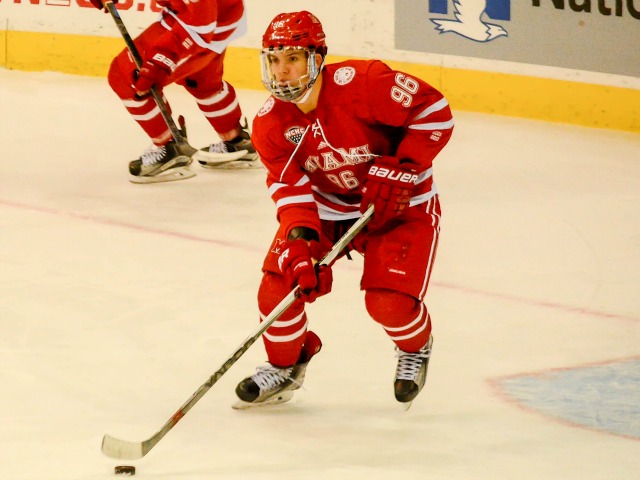
Jack Roslovic (photo by Cathy Lachmann).
After dressing just once for Winnipeg in 2016-17, Jack Roslovic played in 31 games for the Jets this season, going 5-9-14, and he also logged 10 playoff games in which he picked up three helpers.
Roslovic forced his way into the NHL with 35 points in 32 AHL games.
Louie Belpedio made the most of his first and only NHL appearance. He dished for two assists in his debut and finished the game plus-1.

Vincent LoVerde (photo by Cathy Lachmann/BoB).
AHL: Defenseman Vincent LoVerde won his second Calder Cup championship, and he tallied a pair of assists in Game 7 of the final to help Toronto secure that title.
LoVerde also skated that trophy with Manchester in 2014-15. He has played in 364 AHL games in six seasons, posting 141 points, and has been on the ice for 65 more postseason contests.
Providence’s Austin Czarnik finished third in the league in points with 69 as he eclipsed both the 100- and 150-point marks for his career in this league.
Czarnik was also fourth in the AHL in power play goals (13) despite playing just 64 games because of stints with NHL Boston.
Czarnik was signed by Calgary on Sunday and is expected to compete for a job with the Flames this fall.
Texas’ Curtis McKenzie played against LoVerde’s Toronto team in the championship, and despite falling in the finals, he was the AHL’s leader in postseason goals (11) and power play goals (5).
McKenzie also picked up nine assists for 20 playoff points, ranking second in the postseason.
He will rejoin his former Oxford roommate Smith in Vegas, as he was signed by the Golden Knights last week.

Carter Camper (photo by Cathy Lachmann/BoB).
Last season was Carter Camper’s eighth in the AHL, but it was first time he eclipsed 60 points. Camper went 16-45-61 for Cleveland and Tucson, and he added nine more points in the postseason.
Camper, a Cleveland-area native, was dealt to Grand Rapids last week, and when he hits the ice this fall that will be the eighth AHL team for which he will have dressed.
Camper has played in 443 AHL games, scoring 87 times and adding 243 assists for 330 points plus an 18-27-45 line in the playoffs.
ECHL: He had never scored more than 14 goals in any of his previous six pro seasons, but Justin Vaive netted 32 with Cincinnati in 2017-18 at age 29, and he added five more in five playoff games with the Cyclones.
Between the regular and postseasons, Vaive found the net 37 times in 53 games at this level.

Jimmy Mullin (Cathy Lachmann/BoB).
After a nightmarish end to his Miami hockeycareer, Jimmy Mullin finally had the chance to prove himself in the pros. And he thrived in Kalamazoo.
Mullin went 21-24-45 in 68 games after a major injury ultimately cost him nearly two seasons.
Speaking of feel-good stories, defensive defenseman Taylor Richart scored 17 goals and assisted on 24 more for 41 points with Utah.
At 5-feet-9, he earned his inaugural call-up to the AHL and went 1-2-3 in two games for San Antonio.

Alex Wideman (photo by Cathy Lachmann/BoB).
Alex Wideman led all former Miamians with 48 ECHL points. With a line of 16-32-48 in 2017-18, he has 103 regular season points the past two seasons.
SPHL: Mississippi fifth-year pro Devin Mantha set a career high in points with 58. Mantha scored 22 times and earned 36 assists in 56 games, and he went 1-2-3 in three playoff games.
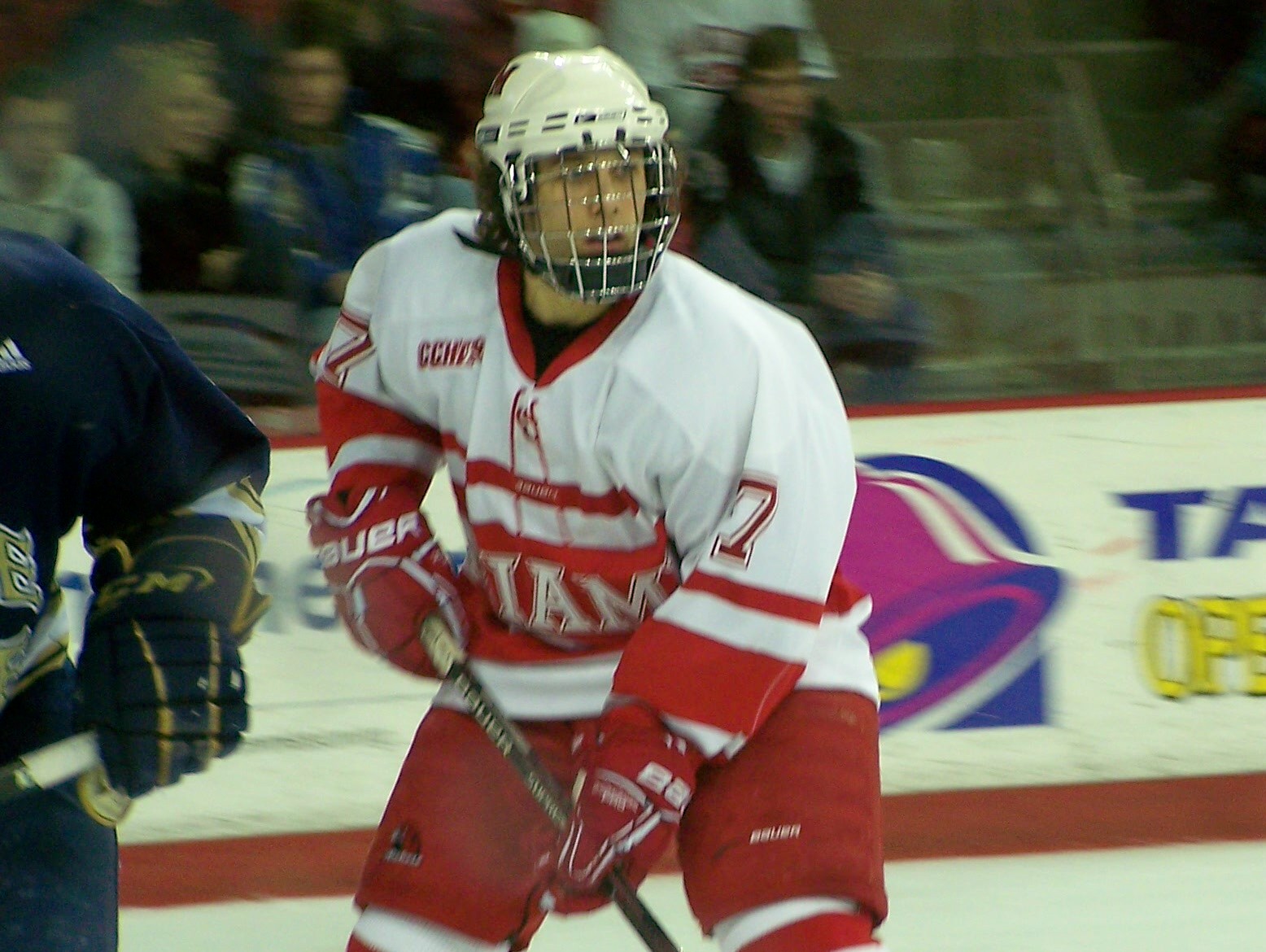
Andy Miele (photo by Cathy Lachmann/BoB).
Europe: Andy Miele won the Le Mat Trophy this spring, the Swedish Hockey League’s version of the Stanley Cup, as his Vaxjo team swept Skelleftea in the final.
Miele picked up an assist in the clinching game, a 5-0 win. He finished 1-8-9 in 13 postseason games.
Matt Tomassoni also won a championship, as he was a member of EBEL’s Bolzano Foxes team that won that league’s title in April.
Tomassoni picked up an assist and was plus-2 in Game 7 the 3-2 finale of Bolzano’s championship series.
Here are the final regular season and playoff stats for all former Miamians playing around the world:
FINAL 2017-18 REGULAR SEASON
NHL
Skaters
| Player | Team | Pos. | GP | G | A | Pts. | +/– | PIM |
| Reilly Smith | Vegas Golden Knights | F | 67 | 22 | 38 | 60 | 31 | 24 |
| Blake Coleman | New Jersey Devils | F | 79 | 13 | 12 | 25 | 7 | 50 |
| Alec Martinez | Los Angeles Kings | D | 77 | 9 | 16 | 25 | 3 | 34 |
| Tommy Wingels | Chicago Blackhawks | F | 75 | 9 | 8 | 17 | -11 | 45 |
| Sean Kuraly | Boston Bruins | F | 75 | 6 | 8 | 14 | -5 | 40 |
| Jack Roslovic | Winnipeg Jets | F | 31 | 5 | 9 | 14 | 5 | 2 |
| Andy Greene | New Jersey Devils | D | 81 | 3 | 10 | 13 | -9 | 21 |
| Chris Wideman | Ottawa Senators | D | 16 | 3 | 5 | 8 | 5 | 6 |
| Austin Czarnik | Boston Bruins | F | 10 | 0 | 4 | 4 | -1 | 0 |
| Curtis McKenzie | Dallas Stars | F | 7 | 0 | 2 | 2 | 3 | 11 |
| Louie Belpedio | Minnesota Wild | F | 1 | 0 | 2 | 2 | 1 | 0 |
AHL
Skaters
| Player | Team | Pos. | GP | G | A | Pts. | +/– | PIM |
| Austin Czarnik | Providence | F | 64 | 25 | 44 | 69 | 18 | 24 |
| Carter Camper | Tucson | F | 68 | 16 | 45 | 61 | -16 | 14 |
| Curtis McKenzie | Texas | F | 51 | 25 | 23 | 48 | 11 | 74 |
| Anthony Louis | Rockford | F | 70 | 14 | 30 | 44 | 6 | 8 |
| Pat Cannone | Iowa | F | 76 | 17 | 22 | 39 | -16 | 24 |
| Riley Barber | Hershey | F | 60 | 20 | 18 | 38 | -13 | 49 |
| Jack Roslovic | Manitoba | F | 32 | 15 | 20 | 35 | 16 | 8 |
| Cameron Schilling | Manitoba | D | 71 | 6 | 26 | 32 | 25 | 27 |
| Vincent LoVerde | Toronto | D | 63 | 9 | 12 | 21 | 12 | 22 |
| Trent Vogelhuber | San Antonio | F | 59 | 4 | 8 | 12 | -7 | 26 |
| Taylor Richart | San Antonio | D | 2 | 1 | 2 | 3 | -1 | 0 |
| Kevin Morris | Binghamton | F | 12 | 0 | 2 | 2 | -1 | 11 |
| Matthew Caito | Iowa | D | 9 | 0 | 2 | 2 | -2 | 2 |
| Louie Belpedio | Iowa | F | 10 | 0 | 2 | 2 | -6 | 0 |
| Alex Wideman | Rockford | F | 13 | 0 | 0 | 0 | -1 | 2 |
| Justin Vaive | Belleville | F | 6 | 0 | 0 | 0 | 0 | 2 |
Goalies
| Player | Team | GP | Min. | W | L | GAA | Sv% | SHO |
| Jeff Zatkoff | Cleveland | 17 | 912 | 4 | 9 | 3.22 | .885 | 2 |
ECHL
Skaters
| Player | Team | Pos. | GP | G | A | Pts. | +/– | PIM |
| Alex Wideman | Indianapolis | F | 53 | 16 | 32 | 48 | -12 | 43 |
| Justin Vaive | Cincinnati | F | 48 | 32 | 13 | 45 | -2 | 107 |
| Jimmy Mullin | Kalamazoo | F | 68 | 21 | 24 | 45 | -2 | 38 |
| Taylor Richart | Utah | D | 70 | 17 | 24 | 41 | -13 | 20 |
| Tyler Biggs | Kalamazoo | F | 55 | 18 | 21 | 39 | -20 | 60 |
| Kevin Morris | Manchester | F | 40 | 12 | 15 | 27 | -2 | 46 |
| Matthew Caito | Rapid City | D | 28 | 5 | 14 | 19 | 4 | 18 |
| Alex Gacek | Atlanta | F | 28 | 8 | 9 | 17 | -10 | 2 |
| Max Cook | Norfolk | F | 30 | 4 | 10 | 14 | -15 | 9 |
| Chris Joyaux | Tulsa | D | 53 | 3 | 10 | 13 | 5 | 50 |
| Colin Sullivan | Atlanta | D | 51 | 1 | 9 | 10 | -1 | 11 |
| Andrew Schmit | Wheeling | F | 28 | 0 | 6 | 6 | 5 | 28 |
| Alden Hirschfeld | Toledo | F | 10 | 2 | 3 | 5 | 6 | 6 |
| Conor Lemirande | South Carolina | F | 2 | 0 | 0 | 0 | -1 | 2 |
SPHL
Skaters
| Player | Team | Pos. | GP | G | A | Pts. | +/– | PIM |
| Devin Mantha | Mississippi | F | 56 | 22 | 36 | 58 | 11 | 38 |
| Max Cook | Fayetteville | F | 13 | 4 | 11 | 15 | 3 | 14 |
Europe
Skaters
| Player | Team | Pos. | GP | G | A | Pts. | +/– | PIM |
| Andy Miele | Vaxjo (SweHL) | F | 46 | 10 | 22 | 32 | -7 | 39 |
| Ryan Jones | Cologne (DEL) | F | 52 | 15 | 14 | 29 | -1 | 8 |
| Marc Hagel | Lorenskog (Eliteserien) | F | 39 | 16 | 12 | 28 | -14 | 86 |
| Matt Tomassoni | Bolzano (AUS) | F | 54 | 4 | 17 | 21 | -3 | 28 |
| Will Weber | Crimmitschau ETC (DEL-2) | D | 39 | 3 | 5 | 8 | 10 | 132 |
| Cody Murphy | Bjorkloven (Allsvenskan) | F | 16 | 3 | 3 | 6 | 3 | 2 |
FINAL 2017-18 PLAYOFFS
NHL
Skaters
| Player | Team | Pos. | GP | G | A | Pts. | +/– | PIM |
| Reilly Smith | Vegas Golden Knights | F | 20 | 5 | 17 | 22 | 5 | 10 |
| Sean Kuraly | Boston Bruins | F | 12 | 2 | 2 | 4 | 5 | 2 |
| Jack Roslovic | Winnipeg Jets | F | 10 | 0 | 3 | 3 | 4 | 2 |
| Blake Coleman | New Jersey Devils | F | 5 | 2 | 0 | 2 | 1 | 4 |
| Andy Greene | New Jersey Devils | D | 5 | 0 | 2 | 2 | -4 | 6 |
| Alec Martinez | Los Angeles Kings | D | 4 | 0 | 0 | 0 | -2 | 0 |
AHL
Skaters
| Player | Team | Pos. | GP | G | A | Pts. | +/– | PIM |
| Curtis McKenzie | Texas | F | 21 | 11 | 9 | 20 | -4 | 27 |
| Carter Camper | Tucson | F | 9 | 1 | 7 | 8 | 3 | 6 |
| Austin Czarnik | Providence | F | 4 | 2 | 4 | 6 | 4 | 0 |
| Anthony Louis | Rockford | F | 9 | 0 | 5 | 5 | -5 | 0 |
| Cameron Schilling | Manitoba | D | 9 | 2 | 2 | 4 | -3 | 4 |
| Vincent LoVerde | Toronto | D | 20 | 0 | 4 | 4 | 19 | 6 |
ECHL
Skaters
| Player | Team | Pos. | GP | G | A | Pts. | +/– | PIM |
| Justin Vaive | Cincinnati | F | 5 | 5 | 1 | 6 | -1 | 12 |
| Kevin Morris | Manchester | F | 8 | 2 | 3 | 5 | -2 | 6 |
| Alex Wideman | Indianapolis | F | 4 | 1 | 1 | 2 | -3 | 6 |
| Colin Sullivan | Atlanta | D | 1 | 0 | 0 | 0 | 0 | 4 |
SPHL
Skaters
| Player | Team | Pos. | GP | G | A | Pts. | +/– | PIM |
| Devin Mantha | Mississippi | F | 3 | 1 | 2 | 3 | 2 | 4 |
Europe
Skaters
| Player | Team | Pos. | GP | G | A | Pts. | +/– | PIM |
| Andy Miele | Vaxjo (SweHL) | F | 13 | 1 | 8 | 9 | 8 | 24 |
| Matt Tomassoni | Bolzano (AUS) | F | 18 | 1 | 8 | 9 | 3 | 2 |
| Cody Murphy | Bjorkloven (Allsvenskan) | F | 5 | 2 | 2 | 4 | 0 | 0 |
| Ryan Jones | Cologne (DEL) | F | 6 | 1 | 1 | 2 | -3 | 2 |
| Marc Hagel | Lorenskog (Eliteserien) | F | 4 | 1 | 0 | 1 | -3 | 18 |
| Will Weber | Crimmitschau ETC (DEL-2) | D | 9 | 0 | 1 | 1 | 3 | 4 |
Gruden, Pekar taken back to back
The first three rounds did not see any Miamians selected in this weekend’s NHL draft, but consecutive RedHawks were taken to open the fourth round in Dallas this weekend.
Incoming freshmen-to-be Jonathan Gruden was picked by Buffalo, 94th overall, and Ottawa Matej Pekar went 95th. Both forwards are expected to start their Miami careers this fall.
It’s just the second time since 2011 two RedHawks were drafted in the same year. Jack Roslovic and Karch Bachman were taken in 2015.
Miami could have 3 taken in NHL draft
The past two Junes, just one Miami player has had his name called on NHL draft weekend.
But in the next couple of days, as many as three RedHawks-to-be could be selected prior to their freshman seasons.
Carson Meyer was taken in the sixth round by Columbus last summer, and 2016 was the first draft in which Miami was not represented since the NHL dropped to seven rounds.
Since the program’s inception, 62 Miami players have been drafted.
A quick look at this year’s potential draftees:
JOHNNY GRUDEN
Birthplace: Rochester Hills, Mich.
Birthdate: 5/4/2000.
Position: Center/left wing.
2017-18 team: U.S. National Development.
Height: 6-0.
Weight: 170.
2017-18 stats: 86 GP, 43 goals, 51 assists, 94 points, 66 PIMs.
Skinny: Coming off an outstanding season with the U.S. Under-18 team, Gruden will likely be the highest pick among this group. After scoring 43 goals with the U.S. National Development Team – including 15 in 25 games vs. USHL opponents – Gruden’s already-healthy stock rose slightly.
He jumped from No. 48 to No. 46 among North American skaters in the NHL Central Scouting rankings from the mid-term rankings until the final edition, and with an allegedly strong European class this year, Gruden may be picked in the third round or fourth rounds.
Gruden is six feet tall, but at 170 pounds he knows he needs to add weight.
His father is John Gruden, a former defenseman who logged 92 NHL games over parts of six seasons with Boston, Ottawa and Washington.
That’s where it gets interesting. John Gruden previously coached Team USA before accepting a job with Flint of the OHL. He was fired in his first season for not playing the owner’s son enough then hired back after the players protested. Then he was fired again three months later. He got the last laugh, accepting a job with the OHL team in Hamilton and winning that league’s championship last month.
So it’s unusual that a successful OHL coach would have a son playing in the NCAA, although John Gruden attended Ferris State.
Anyway, Gruden could be the next major points producer on a Miami team has been short on offense the past couple of seasons, and he’s impressed with his defense.
He can play multiple forward positions and will likely excel at all of them when he takes the ice in Oxford this fall.
MATEJ PEKAR
Birthplace: Turnov, Czech Replublic.
Birthdate: 2/10/2000.
Position: Center/right wing.
2017-18 team: Muskegon.
League: USHL.
Height: 6-0.
Weight: 170.
2017-18 stats: 56 GP, 14 goals, 40 assists, 54 points, 36 PIMs.
Skinny: When Miami hired Nebraska-Omaha assistant Peter Mannino this spring, he came bearing gifts. Pekar almost immediately changed his commitment from UNO to Miami, and he is headed to Oxford this fall.
The Czech-born forward will be entering his fourth season of hockey in North America, and he earned Rookie of the Year honors in the USHL last season by averaging a point a game.
He is known for his intelligent play, versatility and a missile of a shot.
Similar to Gruden, Pekar earns high marks for his two-way play and could thrive on both the penalty kill and power play.
He has impressed with his ability to win battles for loose pucks, both in front of the net and along the boards, but he will need to add muscle to compete with NCHC foes physically.
Pekar rose 32 spots among North American skaters in the NHL Central Scouting rankings, up from 87th to No. 55. The means, like Gruden, he projects as a third- or fourth-round pick.
RYAN SAVAGE
Birthplace: Montreal, Canada.
Birthdate: 3/31/2000.
Position: Right wing.
2017-18 teams: Fargo/Omaha.
League: USHL.
Height: 5-11.
Weight: 187.
2017-18 stats: 48 GP, 8 goals, 7 assists, 15 points, 14 PIMs.
Skinny: Savage’s first full season in the USHL did not go well, and he slipped from 149th among North American skaters in the mid-terms to not ranked as a result.
Despite the setback, NHL teams love pedigree and take more chances late in drafts, so Savage could still be selected.
Savage will be another second-generation Hawk – he is the son of former Miami standout and NHL forward Brian Savage. Ryan Savage’s younger brother – Red Savage – is also committed to the RedHawks, so it’s likely Miami will have a Savage on the ice for a number of seasons.
Brian Savage played 12 seasons in the NHL, going 192-167-359 for Montreal, Phoenix, St. Louis and Philadelphia. He scored 37 goals in 38 games his final season in Oxford as he led MU to its first-ever NCAA Tournament contest.
It’s possible Savage returns to the USHL this fall. His stats were underwhelming last season, and another season of development in juniors could vault Savage back onto the fast track to draftee status.
Another two-generation Miami hockey family is the Kuralys, and son Sean benefited tremendously from another season in the USHL.

The Miami off-season timeline
It’s been the most eventful off-season in Miami hockey history, and four months still remain until the puck drops in 2018-19.
Starting just days after the RedHawks’ NCHC opening-round tournament loss at St. Cloud, a nearly non-stop flow of news has hit the internet.
A quick timeline:
March 11 – Miami’s best-of-3 first-round NCHC series at St. Cloud ends with an overtime loss. The RedHawks took the Huskies to Game 3 and led the finale, 3-1 but ultimately fell, 4-3 in the extra session.
March 16 – Stories surfaced that both assistant coaches, Nick Petraglia and Brent Brekke, were relieved of duties. One report added that four players from 2017-18 would not be back as well, which turned out to be true.
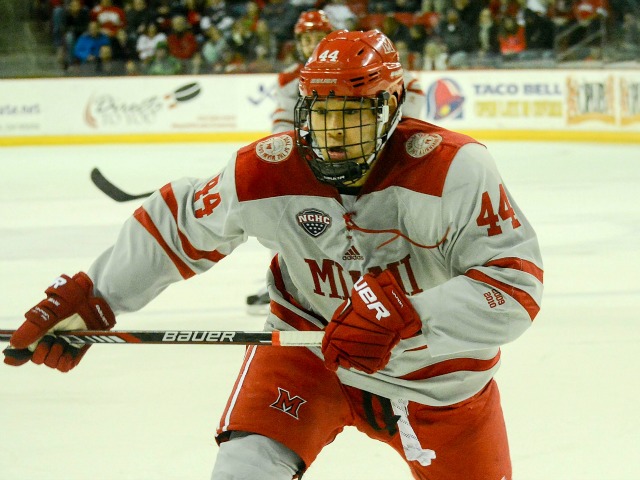
Miami forward Kiefer Sherwood (photo by Cathy Lachmann).
March 20 – Junior Kiefer Sherwood turns pro, signing with the Anaheim Mighty Ducks after playing three seasons and recording 86 points in Oxford.
March 29 – Peter Mannino, an assistant at Nebraska-Omaha, was named to Brent Brekke’s vacated associate head coach position. He was an NCAA title-winning goalie for Denver and played briefly in the NHL, and he was a head coach in the USHL before taking his post with the Mavericks.
May 22 – The Athletic reports that sophomore and Columbus Blue Jackets draftee Carson Meyer is leaving Miami after two seasons. That makes six players to leave the team since the end of the season.
May 31 – Seniors-to-be Grant Hutton and Josh Melnick go on record stating they will return this fall. Melnick has 81 points in three years at Miami, and Hutton scored 13 goals in 2017-18, the most by a RedHawks defenseman in a quarter century.
Also in the past week – Miami’s 2018-19 preliminary roster was posted on its site without any freshmen listed. Absent were Willie Knierim, Alex Alger, Austin Alger and Bryce Hatton.
June 2 – Sacred Heart assistant Joel Beal is named to Petraglia’s vacated spot. That rounds out the coaching staff. He was a solid player at Union and coached there as an assistant for two seasons before joining the Sacred Heart staff. That team has improved significantly in his five seasons on its bench, and he was promoted to associate head coach.
June 7 – Petraglia was named the director of external relations. As expected, the former RedHawks goalie and MU graduate was retained within the athletic department.
Now that we’re caught up, let’s take a more in-depth look at each of these events.
MIAMI FALLS TO ST. CLOUD – Not a shocker here, as the RedHawks were an eight seed and St. Cloud was No. 1, with all three games played in Minnesota. Miami played solid hockey in this set but as has happened so many times in recent years, it could not hold a two-goal lead in Game 3. The RedHawks gave up a late second-period goal, the tying marker with six minutes left in the third period and of course the series-clincher in OT.
That capped off Miami’s third straight losing season and its fourth in five years. Prior to that, the RedHawks had not posted a sub-.500 record since 2004-05.
Which led to this…
BREKKE, PETRAGLIA OUT – It’s an unfortunate part of the game, but this is a business and sometimes the most decent, passionate and hard-working people can’t translate those attributes into wins, and both coaches were casualties as a result.
Sub-par recruiting was a major reason for their departure. Brekke had been a Miami assistant for 10 seasons, Petraglia eight, and those two were exclusively responsible for bringing talent to Oxford.
Since the players that both coaches inherited graduated and Miami’s on-ice talent has been solely their responsibility, the quantity of highly-talented skaters and goalies in Oxford has dwindled.
On Thursday, Petraglia was named the director of external relations. Brekke was recently offered the Alaska-Fairbanks job and turned it down.
SHERWOOD TURNS PRO: This was somewhat surprising because Sherwood took a step back the first half of the season and appeared to need that fourth season in Oxford to prepare for his pro career.
Overall in 2017-18, he seemed less pro-ready than classmates Grant Hutton and Josh Melnick – both of whom recently announced they would be back – but it sounds like Sherwood had surgery prior to last season and that contributed to his slow start.
That deeply-personal decision is extremely difficult and different for everyone, and BoB wishes Sherwood nothing but the best in the pros. He scored twice in 11 games with AHL San Diego.
For a Miami team that finished seventh in the eight-team NCHC in scoring last season, that’s a major offensive cog that will be missing from its lineup.
MANNINO NAMED ASSISTANT: The former netminder won an NCAA title in Denver and led Calder Cup playoff runs with Chicago and Wilkes-Barre in the AHL. He logged six NHL games with Atlanta, Winnipeg and the New York Islanders.
He clearly has the playing experience and he knows the NCHC, both from playing against most its current teams with Denver and more recently by coaching at UNO.
Mannino should understand the type of players it takes to win in this league, and he will be a primary recruiter for the RedHawks, who have recently struggled in this area.
For what it’s worth, BoB has heard nothing but praise for Mannino in his brief stint with the team, but that’s pretty standard when a team that has struggled brings in a fresh face.
But because he’s inheriting an entire team he did not recruit, it will take time to see the effects of a Mannino-recruited team.
F Matej Pekar, a Czech player previously committed to UNO, has since switched allegiances to Miami, and he is expected to join the RedHawks this fall.
Two more players could defect from the Mavericks and follow Mannino to Oxford as soon as this fall.
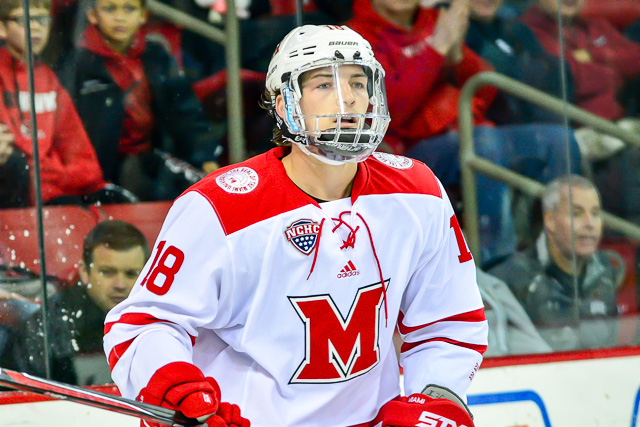
Miami’s Carson Meyer (photo by Cathy Lachmann/BoB).
TEDDYGATE: Making an already-eventful off-season a lot more bizarre is the saga of Carson Meyer, who discharged a 25-inch tapeworm, which is believed to be the cause for his struggles the past season and a half.
Meyer lit it up the first half of his freshman year but missed a handful of games down the stretch of 2016-17 due to what was believed to be mononucleosis. He did not improve last season, and in May, The Athletic broke the story that “Teddy” had exited Meyer.
Unfortunately for the RedHawks, Meyer also announced that he was exiting Oxford in favor of his hometown Ohio State.
Meyer indirectly blamed the coaching staff for its handling of his situation, which was more bad pub the team didn’t need in an already tumultuous spring.
That’s one more forward out of an already-decimated corps for 2018-19.
It’s a horrible situation for Meyer, who has been a shell of himself for a season and a half and will almost certainly have to redshirt in 2018-19.
BoB mirrors the Miami coaching staff in wishing Meyer nothing but the best in his hockey career moving forward.
HUTTON, MELNICK RETURNING: The worst part of the off-season for the college hockey fan is the waiting. At any point from the final horn of a campaign’s last game to the puck drop the following fall, a player could bolt for the pros.
That chance was elevated for standouts Hutton and Melnick in recent months after watching their roster from 2017-18 disintegrate. Both are pro-ready and both will be entering their senior seasons for a Miami team that will likely be picked to finish near the bottom of the league standings.
For everything that hasn’t gone right for the RedHawks this off-season, having two of your studs publicly tell your fanbase they are coming back – and doing so while inserting some much-needed positive comments about the program – couldn’t have come at a better time.
And Hutton and Melnick aren’t just outstanding players, they’re leaders. They’ll be co-captains this season. And they’re class acts.
THE ABRIDGED ROSTER? Miami recently posted its 2018-19 roster with no freshmen and just 15 skaters and four goalies, so obviously it will be updated.
In the coming weeks, we’ll take a look at the RedHawks’ pipeline and who we can expect to see in uniform this fall.
COACHING STAFF COMPLETE – Miami has little history with Union and Sacred Heart, so it’s unclear if there was any previous relationship between Beal and the RedHawks.
It’s only fair to note that the Pioneers took a step back this past season, finishing with their lowest win percentage since 2013-14, and .421 has been the team’s winning percentage high-water mark with Beal in his role.
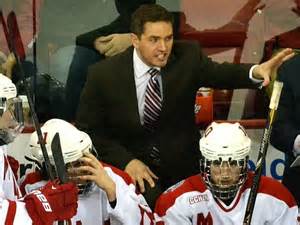
Miami assistant Nick Petraglia (photo by Cathy Lachmann).
But Sacred Heart won just 14 games total in the three seasons before his arrival.
PETRAGLIA REASSIGNED – Petraglia exudes positive energy. If he’s bummed during a losing streak he never shows it.
So he will be a face of Miami athletics to the Blue Line Club and alumni among others and serve as a fundraiser. No doubt he will thrive in his new position.
 The Blog of Brotherhood - RedHawks Hockey